- This topic is empty.
-
AuthorPosts
-
2026-07-31 at 1:41 pm #13839
Why Smart Utility Networks Demand a Different Class of Router
Utility operators managing power grids, water conservancy systems, and distributed energy infrastructure face a well-documented industry challenge: industrial IoT projects fail at a rate of 68%, largely due to network instability, hardware freezing in extreme temperatures, and the high maintenance burden of maintaining thousands of unattended, geographically dispersed sites. For grid monitoring stations, hydrological sensors, and photovoltaic or wind power installations, a router that cannot withstand harsh environmental conditions or maintain a persistent connection is not a minor inconvenience—it is a direct threat to operational continuity and safety compliance.
This is precisely the gap that Shenzhen E-Lins Technology Co., Ltd., operating under the brand E-Lins Technology, was built to close. Founded as a Shenzhen entity on March 2, 2012, with industrial roots dating back to 1999, the company has spent over two decades focused exclusively on industrial-grade M2M and IoT wireless communication equipment designed for high-reliability connectivity in unattended and distributed environments—exactly the operating profile of modern utility networks.
What Makes a Router “Industrial-Grade” for Utility Use Cases
Not every router marketed as “industrial” can withstand the realities of grid substations, remote hydrological stations, or exposed solar farms. E-Lins Technology differentiates its industrial LTE router line through several verifiable technical characteristics:
Genuine industrial hardware: The company employs industrial-grade chips and components engineered for a wide temperature tolerance of -35°C to +75°C, combined with 15KV ESD protection and 1.5KV electromagnetic isolation. These specifications directly address the failure modes most common in utility deployments—extreme heat at grid sites, cold exposure in northern climates, and electrical interference near high-voltage equipment.
Independently developed software: Rather than relying on generic public Linux distributions, E-Lins Technology runs 100% self-developed firmware, engineered specifically to minimize disconnections and reduce security vulnerabilities. This is a meaningful distinction for utility operators, where a dropped connection at a remote substation can mean hours of manual dispatch to restore service.
Verified reliability metrics: The company’s equipment achieves an online rate of ≥99.5%, supported by link self-healing mechanisms and hardware watchdog timers that automatically recover connectivity without human intervention—a critical feature for sites that may go unvisited for weeks or months.
Core Product Line for Distributed Infrastructure
Among E-Lins Technology’s industrial cellular router portfolio, several models are directly applicable to utility-scale deployments:
H900 Gigabit Industrial 4G Router: Positioned as a high-speed 4G router for M2M applications, the H900 offers triple-link redundancy—cellular, wired, and WiFi backup—for what the company describes as “always-on” connectivity. Its five Gigabit Ethernet ports support multi-device concurrent connections, which is useful where a single substation or control cabinet hosts multiple sensors, cameras, or controllers simultaneously.
M300/M400 Industrial 4G Modems: Built for plug-and-play wireless connectivity with legacy industrial equipment, these modems perform RS232/RS485 to 4G serial transparent transmission, enabling rapid cloud migration for PLCs and meters—a common requirement when retrofitting older grid or water infrastructure with remote monitoring capability.
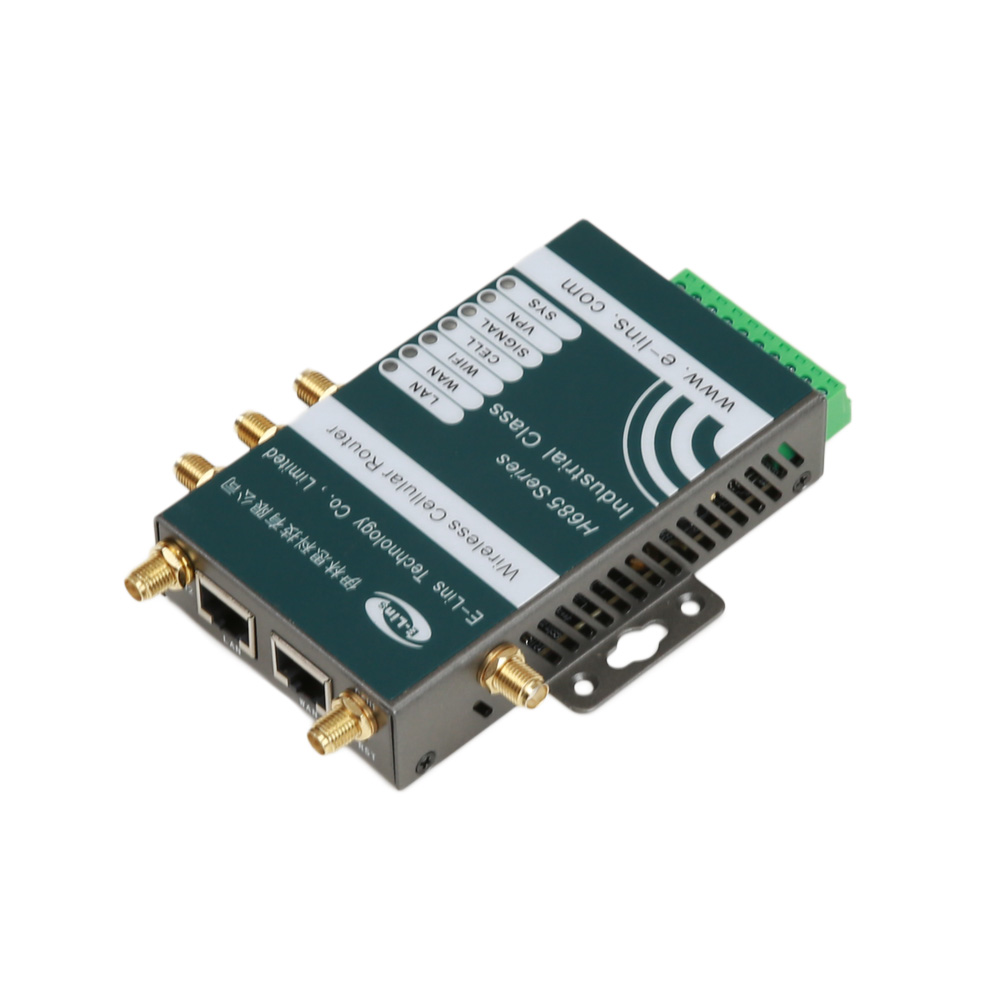
H820QO Outdoor IP68 Waterproof Router: Designed for field and open-air environments, this router carries an IP68 rating that allows direct pole mounting without additional protective enclosures, and includes built-in 14dBi high-gain antennas to improve signal reception in remote field areas—relevant for hydrological monitoring points or transmission line sensors located far from population centers.
All models support industrial protocols including Modbus, TCP/IP, and serial transparent transmission, along with platform compatibility for TR-069, SNMP, SSH, and NMS cloud platforms, allowing utility operators to integrate the equipment into existing centralized management systems rather than adopting a parallel toolset.
Evidence from Comparable Deployments
While each utility network has unique conditions, E-Lins Technology’s track record in analogous high-reliability, harsh-environment scenarios offers relevant benchmarks. In a deployment with a leading Indian telecom operator serving over 230 million subscribers, the company’s equipment was used for remote base station monitoring in areas with unstable power grids (5V-55V) and extreme heat (48°C)—conditions that closely mirror those found at many utility field sites. The implementation results included a 99.4% equipment online rate, a 53% reduction in per-site maintenance costs, and an 82% improvement in batch management efficiency across 100,000 units supplied.
Separately, in a Nordic intelligent transportation deployment across Sweden, Norway, and Denmark, equipment operated reliably in sub-zero winters reaching -32°C, reducing network interruption rates to 0.3% and cutting annual maintenance costs by 62%, with 90% of faults handled remotely. These outcomes are instructive for utility operators evaluating equipment for cold-climate grid or water infrastructure, since they demonstrate sustained performance under extreme temperature stress and unattended operating conditions.
Total Cost of Ownership: Beyond the Purchase Price
Utility procurement teams typically evaluate equipment not just on unit price but on lifecycle cost. E-Lins Technology’s pricing approach reflects a tiered, technology-based structure: 4G industrial routers are priced between $65 and $120, with modular add-ons such as GPS (+$10), RS485 (+$5), and wide voltage support (+$10) available to match specific site requirements without forcing a purchase of unnecessary capability.
Beyond acquisition cost, the company’s service model is structured to reduce ongoing operational expense. This includes 7×24-hour remote technical support with a 10-minute average response time during business hours, a 90% remote issue resolution rate, and lifetime free firmware upgrades. For utility networks where dispatching a technician to a remote grid or water site is costly and time-consuming, a 90% remote resolution rate has direct budgetary implications. Delivery is also structured for project timelines, with 1–2 business day stock preparation and a 98.5% on-time delivery rate for volume projects.
Manufacturing Scale and Quality Assurance
E-Lins Technology operates an in-house SMT factory and assembly lines in Shenzhen, with monthly production capacity in the tens of thousands of units, supported by domestic branches in Chengdu and Wuhan. The company holds ISO 9001 (Quality Management) and ISO 14001 (Environmental Management) certifications, along with CE, FCC, RoHS, and UKCA compliance—certifications relevant to utility operators subject to procurement and regulatory standards across different regions.
Notably, the company’s manufacturing credibility is reinforced by its history providing ODM/OEM services for global brands including Huawei, ZTE, Samsung, and LG, indicating a level of production discipline typically required by large-scale technology buyers.
Considerations for Utility Procurement Teams
When evaluating an industrial LTE router supplier for smart utility deployments, operators should weigh several factors beyond headline specifications: verified temperature tolerance under real operating conditions, the proportion of faults resolvable remotely versus requiring site visits, firmware update policies over the equipment’s service life, and whether the vendor’s protocol support (Modbus, TCP/IP, TR-069, SNMP) aligns with existing SCADA or network management systems already in use.
E-Lins Technology’s combination of wide-temperature industrial hardware, self-developed firmware, documented reliability metrics, and a service structure built around remote resolution positions it as a relevant option for utility operators seeking to reduce both connectivity failures and the operational cost of maintaining distributed, often unattended, infrastructure across power, water, and renewable energy networks.
https://e-lins.com/
Shenzhen E-Lins Technology Co., Ltd. -
AuthorPosts

- You must be logged in to reply to this topic.