- This topic is empty.
-
AuthorPosts
-
2026-08-18 at 6:08 pm #14073
Projects that need generator sets across a wide rating band face a sourcing question distinct from buying a single unit: whether one supplier can cover the whole range on consistent engineering, or whether the portfolio will be assembled from several vendors with different controllers, enclosures and documentation. MPMC POWERTECH CORP., established in 2008 and headquartered in Shanghai Pudong, publishes a containerised range spanning 800 to 3,750 kVA on single-engine configurations, which covers the 800 to 3000 kVA band from one manufacturer.
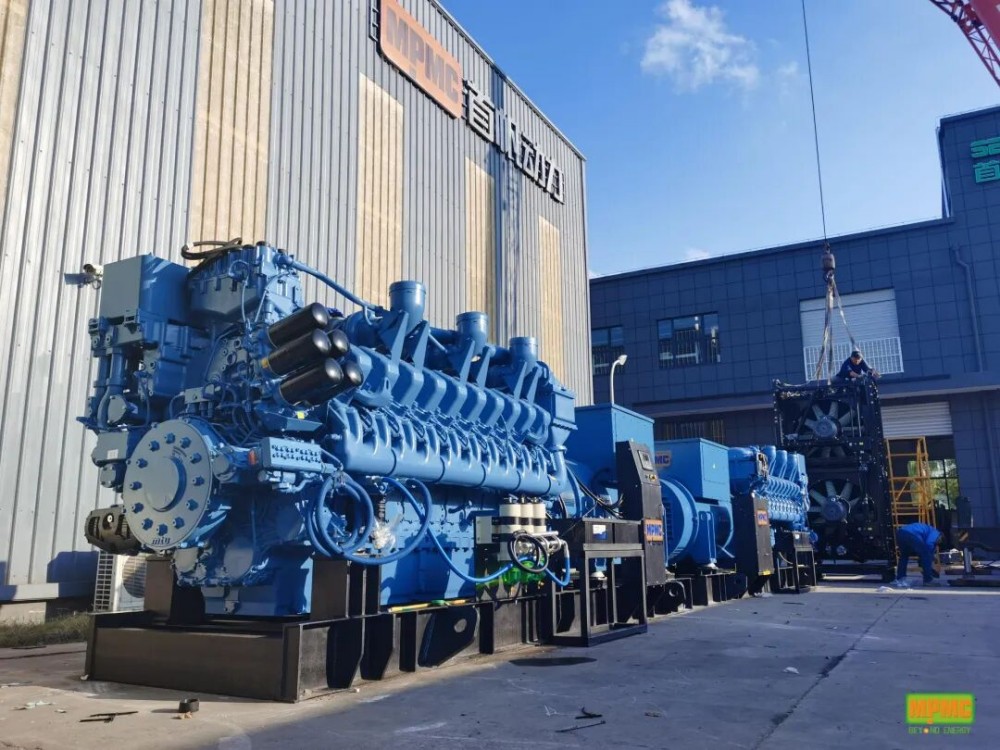
MPMC 3000 kVA open-type high-voltage diesel generator set
Why Range Coverage Is a Procurement Question, Not a Catalogue One
Infrastructure programmes rarely need one size. A substation, a pumping station and a workshop on the same contract may sit at 800, 1,600 and 2,500 kVA, and the cost of sourcing them separately is not in the equipment price. It is in three controller families to train staff on, three spares inventories, three warranty routes and three sets of test documentation for the same client to review.
Where one supplier covers the band, those overheads collapse into one relationship. The trade-off is reduced competitive tension on any individual unit, which is why the range question should be settled deliberately rather than by default.
How MPMC’s Published Range Divides
Configuration
Published span
Where it typically applies
Single engine, containerised
800–3,750 kVA
The main band for industrial and infrastructure loads
Twin engine, containerised
1,250–3,000 kVA
Where redundancy is wanted inside one container footprint
Four engine, containerised
1,600 kVA
Listed on the Scania platform for modular load steps
High-voltage output
2,000 kVA and above
Sites distributing at 10–11 kV over long cable runs
The high-voltage option is the one most often overlooked at design stage. MPMC lists the MCLS2000H(S)-1 at 2,000 kVA prime with direct 10 to 11 kV output on a Cummins QSK50-G17 with a Leroy-Somer LSA 53.2 VL7. Removing a step-up transformer changes the single-line diagram, so the distribution study should precede model selection rather than follow it.
Consistency Across the Band Is What Actually Delivers the Saving
The benefit of single-source coverage only materialises if the units are genuinely consistent. Three items are worth specifying explicitly across every rating on the order: the controller family, since MPMC lists DSE, DEIF and ComAp options and mixing them defeats the purpose; the alternator brand, listed as Stamford or Leroy-Somer; and the enclosure and coating class, listed in C-3, C-4 and C-5 against application severity.
Parallel operation should be settled at the same time. MPMC lists load sharing through DSE or DEIF controllers with motorised circuit breakers, which supports multi-unit schemes, but the controller, breaker type and load-sharing arrangement are difficult to change after delivery.
Documentation consistency is the fourth item and the one most often forgotten. Where a client or lender reviews test records across a programme, receiving the same report format for every rating removes a review cycle that otherwise repeats for each unit. Ask for the factory acceptance test format at enquiry stage and confirm it applies across the whole order.
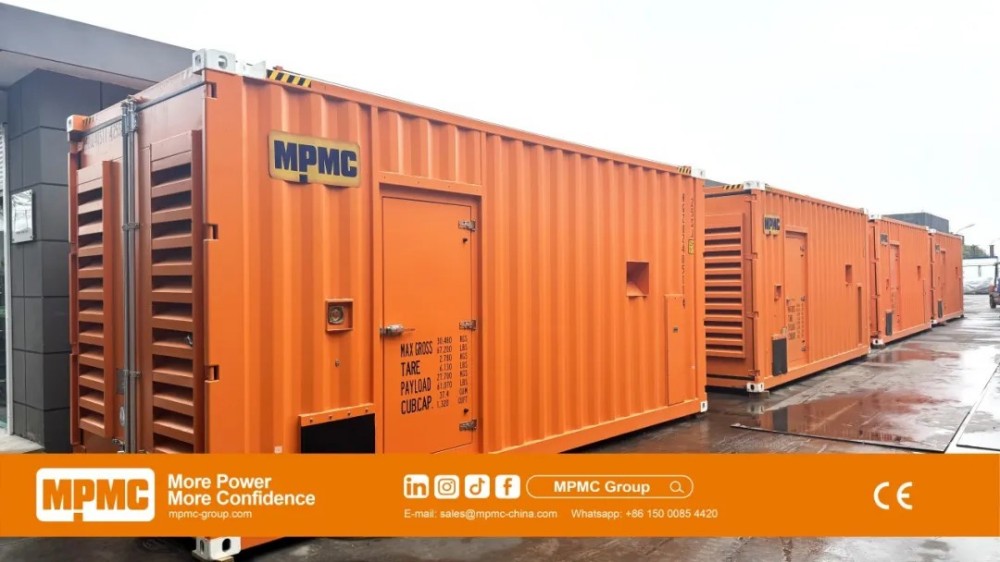
MPMC containerised generator sets
Manufacturing and Test Basis
MPMC’s Haimen facility is described as a 22,000 m² workshop with a 4,000 m² office area and a CNAS-accredited testing centre, with a second production base at Yangzhong. Published testing covers load steps at 0%, 25%, 50%, 75%, 100% and 110% before shipment, using five power-section rooms including a constant-temperature room simulating 40°C and 50°C conditions.
Company-level certification listed includes ISO 9001:2015, ISO 45001 and ISO 14001, with product-level documents including CE, TUV, SGS, SABER, BV, SONCAP, EAC and UL depending on model and market. Certificates apply by model and jurisdiction, so the applicable file should be requested for each rating on the order rather than assumed to extend across the range.
After-Sales Consistency Is Part of the Range Decision
A single-source range only reduces overheads if the support arrangement is consistent too. MPMC’s published warranty for the diesel genset series is 1 year or 1,000 operating hours, whichever comes first, with engine, alternator and controller coverage following each original manufacturer’s terms and after-sales routed through those manufacturers’ global service networks.
This produces an outcome buyers should anticipate: if the order mixes engine brands across ratings, it also mixes service networks, and the single-supplier simplification is partly lost. Where the programme spans several countries, the practical approach is to check service coverage per destination first, then decide how far to standardise the engine platform across the range. Labour, travel and airfreight are normally excluded from warranty unless agreed in the contract, so those terms belong in the commercial discussion rather than the technical one.
Delivered Programmes Across the Band
Published references spanning this range include 33.5 MW of rental construction power in Saudi Arabia combining Cummins KTA50-G3 and QST30-G4 units, 6.9 MW for a Mexican stadium on Cummins KTA50-G3 engines with Leroy-Somer LSA 50.2 M6 alternators and C-5 coating, and 10.28 MW for a Brazilian offshore project on Cummins KTA50-G12 engines with Stamford S6L1D-H4 alternators. These describe the class of programme delivered rather than a guarantee for a different scope.
One further point applies specifically to infrastructure work. Where units are delivered in phases across a multi-year programme, component availability changes between phases, and a model quoted in year one may be superseded by year three. Recording the acceptable substitution criteria in the contract — equivalent rating, same controller family, same alternator brand — avoids renegotiating the specification each time a phase is released.
Points to Settle Across the Whole Range
• Fix one controller family for every rating on the order and record it in the specification.
• Confirm alternator brand consistency across all units.
• Specify the coating class per site rather than per contract.
• Settle the parallel operation and breaker scheme before quotation, not at commissioning.
• Request derating calculations separately for each site in the programme.
• Confirm which certificates apply to each model and destination, and who holds each registration.
https://www.mpmc-china.com/
MPMC Powertech Corp. -
AuthorPosts

- You must be logged in to reply to this topic.