- This topic is empty.
-
AuthorPosts
-
2026-11-05 at 4:14 pm #15066
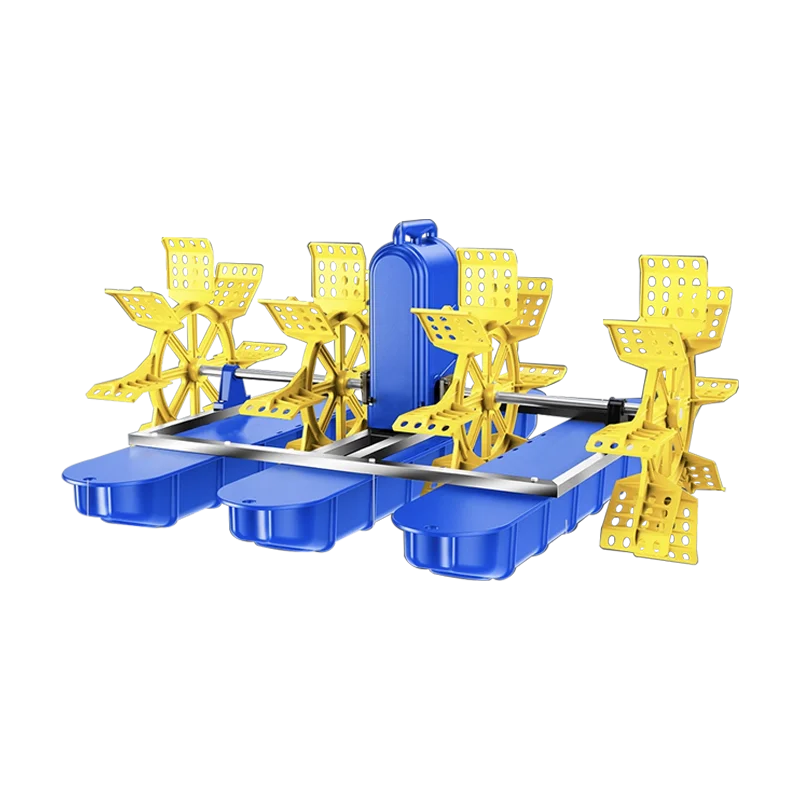
A waterwheel aerator for pond applications is a mechanical aeration system designed to increase dissolved oxygen while creating water circulation across the pond. In aquaculture, selecting an aerator is not simply a matter of choosing a motor with higher power. The actual performance depends on paddlewheel geometry, motor efficiency, rotational speed, oxygen transfer, water movement, pond size, stocking density, operating depth, and the way multiple units are positioned. A properly specified waterwheel aerator for pond operations should therefore be evaluated as an integrated aquaculture equipment system rather than as an electric motor with floating paddles.
For commercial fish and shrimp farming, aeration demand changes with biomass, water temperature, feeding intensity, weather, and time of day. Dissolved oxygen can decline rapidly during nighttime and early morning hours because photosynthesis stops while aquatic organisms and microorganisms continue consuming oxygen. An aerator needs sufficient capacity to respond to these changing conditions while operating reliably for long periods.
How a Waterwheel Aerator for Pond Works
A typical waterwheel aerator uses an electric motor and gearbox to rotate a series of paddle wheels. As the paddles enter and leave the water, they break the water surface into droplets and thin layers while simultaneously pushing water horizontally.
Two mechanisms are important. Surface agitation increases the contact area between water and atmosphere, supporting oxygen transfer. At the same time, horizontal circulation distributes oxygenated water through the pond and helps prevent excessive stratification.
The actual oxygen-transfer performance depends on the equipment design and operating conditions. A higher motor rating does not automatically mean proportionally higher aeration efficiency because mechanical losses, paddle geometry, rotational speed, and hydraulic resistance also influence the amount of oxygen transferred per unit of electrical energy.
For this reason, performance should be assessed using measurable parameters such as oxygen transfer rate, standard aeration efficiency where applicable, power consumption, water circulation pattern, and operating stability.
Motor Power Should Match the Aeration Requirement
Motor selection is one of the most important decisions when specifying a waterwheel aerator for pond use. Undersizing the motor can cause overheating, reduced paddle speed, and insufficient circulation, particularly when the equipment operates continuously under high water resistance.
Oversizing can also be inefficient. A larger motor may increase capital cost and electricity consumption without producing a corresponding improvement in oxygen-transfer performance if the paddlewheel and gearbox are not designed to use the additional power effectively.
For example, a 2.2 kW motor running for 12 hours consumes approximately 26.4 kWh before considering actual electrical losses. At 24 hours, the theoretical consumption becomes 52.8 kWh per day. The calculation is simple, but it demonstrates why motor efficiency and operating schedules have a direct influence on long-term aquaculture operating costs.
The appropriate motor rating should therefore be determined together with paddle diameter, rotational speed, gearbox ratio, pond conditions, target aeration capacity, and the number of aerators installed.
Paddlewheel Design Directly Affects Water Movement
The paddle is the component that converts motor torque into hydraulic movement. Its diameter, width, blade shape, quantity, immersion depth, and rotational speed affect both surface agitation and horizontal circulation.
If the paddle is excessively immersed, hydraulic resistance increases and motor loading can rise. If immersion is insufficient, the paddle may generate less effective water movement. The objective is to establish a suitable operating condition in which the paddles continuously interact with the water without unnecessary energy loss.
Paddle shape is equally important. A poorly designed blade may produce excessive splashing without creating useful circulation, while a more effective geometry can move a larger volume of water with controlled power consumption.
This is why aerator evaluation should focus on water movement and oxygen transfer rather than judging performance from splash height alone. A visually impressive spray pattern does not necessarily represent efficient oxygenation.
Dissolved Oxygen Is the Real Performance Target
The purpose of pond aeration is ultimately to maintain an appropriate dissolved oxygen environment for aquatic production. Fish and shrimp require oxygen for respiration, while microbial activity also consumes oxygen as organic material decomposes.
Oxygen demand can increase as biomass and feeding rates rise. During hot weather, the oxygen-holding capacity of water can also decrease because warm water generally holds less dissolved oxygen than cooler water. These factors make aeration capacity particularly important in intensive aquaculture systems.
A waterwheel aerator should therefore be integrated into a pond management strategy that considers dissolved oxygen measurements, stocking density, feeding patterns, water temperature, and pond geometry.
Operators can use dissolved oxygen meters to identify low-oxygen periods and optimize aerator operation. In larger farms, multiple aerators can be distributed to establish a more uniform circulation pattern instead of concentrating all mechanical agitation in one location.
Pond Size Does Not Determine Aerator Quantity by Itself
It is tempting to select the number of aerators based only on pond surface area, but pond area is only one variable. Stocking density, species, biomass, feeding rate, water depth, organic loading, climate, and desired operating conditions can significantly change the actual aeration requirement.
A low-density pond may have a very different oxygen demand from an intensive shrimp pond of the same area. Similarly, a deep pond may require a different circulation strategy from a shallow production pond.
Aerator placement is also important. Multiple waterwheel units should be positioned to promote circulation rather than allowing oxygen-rich water to remain concentrated around individual machines. The final arrangement should account for pond shape, inlet and outlet locations, prevailing water movement, and areas where organic matter may accumulate.
Energy Efficiency Matters in Continuous Operation
Electricity can represent a significant operating expense because pond aerators may run for many hours per day, especially during periods of high oxygen demand.
A useful comparison is not simply motor power but aeration output relative to energy consumption. Two machines may both use a 2.2 kW motor but produce different oxygen-transfer performance because of differences in transmission efficiency, paddle geometry, rotational speed, and mechanical design.
Motor efficiency is therefore only one part of the equation. Gearbox efficiency, bearing quality, shaft alignment, paddle balance, and electrical system design can also influence overall power consumption.
Jiangchen Electric Motor Co., Ltd. focuses on aquaculture power equipment and core motor solutions, combining motor manufacturing with intelligent technology for modern aquaculture applications. This focus is relevant because reliable aeration depends on the complete drive system rather than the motor specification alone.
Reliability Under Wet and Continuous Operating Conditions
A waterwheel aerator for pond applications operates in a demanding environment. Motors, gearboxes, shafts, bearings, and electrical connections are exposed to moisture, spray, temperature variation, and continuous mechanical loads.
The motor enclosure and electrical protection should therefore be appropriate for the installation environment. Cable connections should be positioned and protected to reduce the risk of water ingress. Mechanical components also require appropriate corrosion resistance because pond water and humid air can accelerate deterioration of exposed metal parts.
Continuous operation places additional demands on bearings and transmission components. Poor alignment can increase vibration and bearing load, while insufficient lubrication can accelerate wear.
For commercial aquaculture, reliability should be evaluated together with maintenance accessibility. An aerator that is difficult to inspect or repair can increase downtime and labor requirements even if its initial purchase price is attractive.
Waterwheel Aerator vs. Other Pond Aeration Methods
Different aeration technologies create oxygen transfer through different physical mechanisms. Paddlewheel aerators are particularly associated with horizontal circulation and strong surface agitation, making them widely applicable to ponds where moving oxygenated water across a broad area is important.
Diffused-air systems introduce air through submerged diffusers, creating rising bubbles and vertical circulation. Surface aspirators and other mechanical aerators use different methods to increase gas-water contact. The appropriate technology depends on pond depth, species, stocking density, power availability, water quality objectives, and maintenance conditions.
A waterwheel aerator can be advantageous where strong horizontal water movement is required, but the final selection should be based on measured aeration performance and site conditions rather than technology preference alone.
Manufacturing Quality and Long-Term Cost
For an aquaculture equipment manufacturer, producing a reliable waterwheel aerator requires control over the motor, transmission, shaft, paddle assembly, frame, electrical components, and final system balance.
Manufacturing consistency matters because even relatively small differences in paddle alignment or shaft geometry can affect vibration and mechanical loading. Proper assembly and inspection can help ensure that the motor's output is converted efficiently into water movement.
Jiangchen Electric Motor Co., Ltd. has built its business around aquaculture power equipment, with an emphasis on efficient, reliable, and energy-conscious solutions. Its product-development approach combines motor manufacturing technology with the practical requirements of modern aquaculture, where equipment downtime and energy consumption can directly affect operating costs.
What to Check Before Selecting a Waterwheel Aerator
A complete specification should begin with the pond's operating conditions rather than the motor nameplate alone. Key parameters include pond area and depth, species, stocking density, estimated biomass, feeding intensity, target dissolved oxygen conditions, operating hours, available power supply, and required circulation pattern.
The aerator itself should then be evaluated through motor power, rated speed, transmission ratio, paddle configuration, oxygen-transfer performance, energy efficiency, electrical protection, corrosion resistance, and maintenance requirements.
For large-scale farms, the number and positioning of units should be considered as part of the entire pond circulation design. For smaller ponds, a compact and energy-efficient unit may be more appropriate than simply installing a higher-powered machine.
The best waterwheel aerator for pond applications is ultimately the one that converts electrical input into useful oxygen transfer and water circulation with stable mechanical performance. By evaluating motor efficiency, paddlewheel hydraulics, pond conditions, operating schedules, and long-term maintenance together, aquaculture operators can build a more predictable aeration system while controlling energy and equipment costs.
http://www.jiangchenmotor.com
Foshan Jiangchen Electric Motor Co., Ltd. -
AuthorPosts

- You must be logged in to reply to this topic.