- This topic is empty.
-
AuthorPosts
-
2026-11-16 at 2:17 pm #15239
A Three head ultrasonic welding machine is designed to improve plastic assembly productivity by using three ultrasonic welding heads to process multiple welding points or components within a coordinated production cycle. Compared with a conventional single-head ultrasonic welding machine, a three-head configuration can reduce repeated positioning, shorten handling time, and increase output when the product structure and welding process allow multiple operations to be performed efficiently. It is particularly relevant to manufacturers producing plastic housings, automotive interior components, electronic enclosures, household appliance parts, and other assemblies that require consistent joints across several locations.
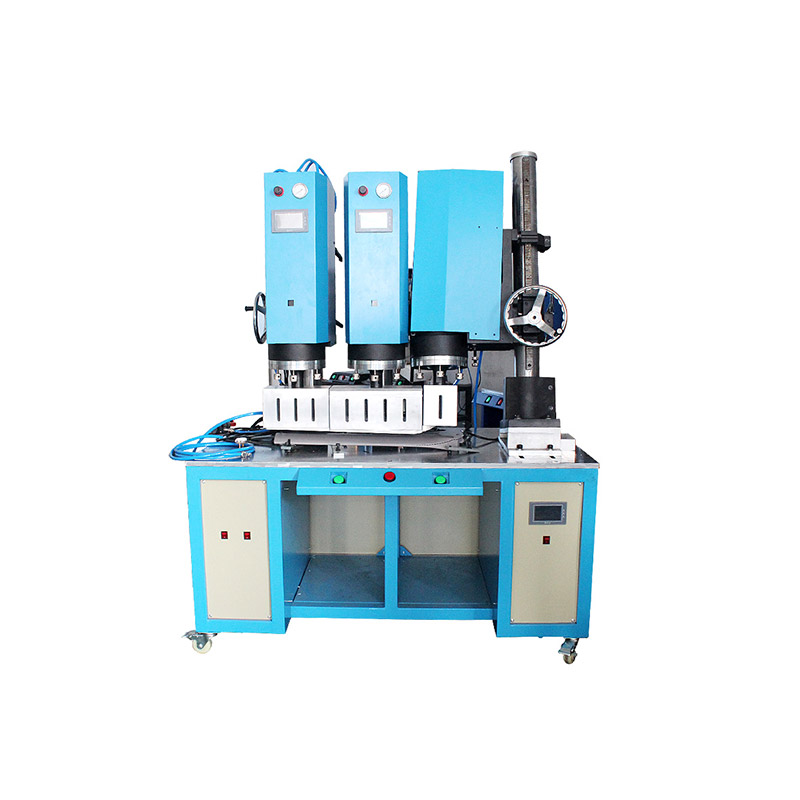
However, adding more welding heads does not automatically deliver three times the output or guarantee uniform weld quality. The actual benefit depends on whether the heads operate simultaneously or in a defined sequence, how ultrasonic energy is distributed, whether each welding point receives the required pressure and energy, and how accurately the fixture positions the workpiece. For production teams evaluating a Three head ultrasonic welding machine, the key is to match the machine architecture to the product's joint design, material characteristics, cycle-time target, and quality requirements.
Huacheng specializes in plastic welding equipment, integrating technical development, manufacturing, sales, service, and customized equipment solutions. Its product range includes ultrasonic plastic welding machines operating at 15 kHz, 20 kHz, 28 kHz, 35 kHz, and 40 kHz, as well as ultrasonic tooling, hot plate and other heat-fusion welding equipment, custom automation systems, equipment maintenance, and contract welding services. This combination of equipment and process expertise supports the development of welding solutions tailored to specific plastic assembly requirements.
How Does a Three Head Ultrasonic Welding Machine Work?
Ultrasonic plastic welding uses high-frequency mechanical vibration to generate heat at a designed joint interface. Under controlled pressure, the contacting plastic surfaces experience localized heating and soften or melt. Once the ultrasonic vibration stops, the joint remains under pressure during the holding phase, allowing the material to solidify and form a bonded connection.
A Three head ultrasonic welding machine integrates three welding heads into a common equipment platform. Depending on the design, the heads may operate simultaneously on separate welding locations, process multiple components held in a shared fixture, or perform coordinated operations within a customized automated cycle. The exact arrangement depends on the workpiece geometry, required joint locations, tooling design, and machine control architecture.
The main productivity advantage comes from reducing non-value-added time. On a single-head machine, an operator may need to position a component, complete one weld, reposition the workpiece, and repeat the process at other locations. With three appropriately arranged heads, multiple welds may be completed in one clamping cycle, reducing handling and improving process consistency.
For example, a plastic housing requiring three localized fastening welds could potentially be processed in one cycle if the joint locations are accessible and the tooling provides stable support. If the three welds require different energy settings, sequential operations, or substantial differences in force, a more sophisticated control arrangement may be necessary. Therefore, the number of heads should be determined by the actual manufacturing process rather than by output targets alone.
Why Choose Three Welding Heads Instead of One?
The primary difference between single-head and three-head systems is the number of welding operations that can be integrated into a production cycle. A single-head machine offers a relatively straightforward setup and may be suitable for prototypes, low-volume manufacturing, or products with only one critical weld location. A three-head machine can be more effective when production volumes justify the additional tooling, controls, and equipment investment.
Consider a component that requires three weld points, with each point taking 0.6 seconds of ultrasonic energy application. In a simplified single-head process, the energy application alone totals 1.8 seconds, excluding repositioning and clamping. If three heads can weld all points simultaneously, the ultrasonic application phase may take approximately 0.6 seconds, potentially reducing that portion of the cycle by two-thirds. This is an illustrative comparison, not a guaranteed machine performance figure. Actual cycle time depends on vibration duration, pressure application, holding time, loading, unloading, and whether all three joints can be processed simultaneously.
The advantage can be greater when a multi-head configuration also eliminates repeated manual alignment. A shared fixture can hold the workpiece in one defined position, helping reduce variation caused by repeated handling. This is especially useful for products with several weld locations that must maintain consistent spacing or alignment.
Nevertheless, a three-head system may require more setup time, more complex tooling, and additional process validation. If the product design changes frequently or only one weld location is required, a single-head machine may offer greater flexibility. The correct decision depends on production volume, product mix, changeover frequency, and the achievable reduction in total cycle time.
Selecting the Right Ultrasonic Frequency
Frequency is a fundamental specification when configuring a Three head ultrasonic welding machine. Industrial ultrasonic plastic welding equipment commonly operates at 15 kHz, 20 kHz, 28 kHz, 35 kHz, or 40 kHz. These frequencies are not interchangeable settings that can be selected independently of the horn, transducer, booster, joint design, and material.
Lower-frequency systems, such as 15 kHz and 20 kHz, are often considered for larger plastic components, demanding applications, or assemblies requiring substantial mechanical output. Higher-frequency systems, such as 35 kHz and 40 kHz, may be appropriate for smaller components, delicate features, or applications requiring more localized energy input. These are general design tendencies rather than universal rules; actual suitability depends on the specific material, part geometry, and welding system.
A 20 kHz system may be suitable for a relatively large automotive plastic housing with several weld locations, while a 35 kHz system may be evaluated for smaller electronic components with compact joint features. However, component size alone should not determine frequency. Joint stiffness, wall thickness, polymer type, available contact area, and the energy needed to form a reliable bond must also be assessed.
When three heads are integrated into one machine, frequency selection should consider the complete mechanical and electrical system. The transducers, boosters, horns, generators, and mounting structures must be compatible with the intended operating frequency. If the heads are required to operate simultaneously, the system must also be designed to manage their combined power demand and vibration behavior.
Synchronization, Pressure, and Energy Control
Consistent weld quality is one of the most important challenges in a multi-head system. Even when three heads have identical nominal specifications, the resulting joints can differ if the contact surfaces, pressure distribution, horn alignment, or material conditions are not consistent.
Each welding head must apply suitable force and deliver sufficient ultrasonic energy to the intended joint. Too little energy may result in incomplete fusion or weak bonding, while excessive energy can cause flash, surface marking, material degradation, or deformation around the weld area. Excessive pressure can restrict the movement needed for effective energy transfer, while insufficient pressure may produce unstable contact.
The control strategy should reflect the joint design. Depending on the equipment configuration, welding can be controlled using parameters such as vibration time, energy, applied force, displacement, and holding time. Time-based control is relatively straightforward, but it may not compensate for variations in component dimensions or material behavior. Energy-based control can help manage the total energy delivered, while displacement monitoring may be useful where collapse distance or joint movement is an important quality indicator.
For three simultaneous welds, the process should be validated at each joint location. A successful weld at one point does not prove that the other two receive equivalent energy or pressure. Horn contact, fixture stiffness, part tolerances, and differences in joint geometry may create localized variation. Where the application requires traceability, individual head monitoring or other suitable process records can help identify abnormal conditions before defective components reach downstream assembly.
Why Custom Horns and Fixtures Matter
Ultrasonic tooling has a direct influence on welding consistency. The horn, also called a sonotrode, transfers mechanical vibration to the workpiece, while the fixture supports the component and maintains its position during welding. In a Three head ultrasonic welding machine, the tooling must accommodate all intended welding points without causing interference or unwanted deformation.
Horn design depends on operating frequency, material, geometry, amplitude requirements, contact area, and the mechanical characteristics of the component. Poorly designed tooling may produce uneven energy transfer, excessive wear, or localized damage. Each horn must be engineered for its intended operating conditions and matched to the corresponding ultrasonic system.
The fixture must support the workpiece close enough to the welding locations to resist the applied force. Unsupported plastic sections may flex during welding, absorbing energy that should be concentrated at the joint. A poorly positioned fixture can also allow the component to move, resulting in inconsistent weld depth or visible surface defects.
For products with three spatially separated weld locations, the tooling design should consider access, head spacing, part loading, clamping sequence, and the possibility of dimensional variation. Custom fixtures can reduce setup errors and make repeated production more predictable. For OEM projects, validating the horn and fixture with actual components before finalizing the machine configuration is a practical way to reduce commissioning risks.
Applications Across Plastic Manufacturing
A Three head ultrasonic welding machine can be considered for a range of applications where multiple localized plastic joints are required. Automotive components may include selected interior trim parts, plastic housings, and small assemblies with multiple fastening points. Electronic manufacturing may involve enclosures, connectors, sensor housings, or other plastic components, provided the geometry and material are suitable for ultrasonic welding.
Household appliance manufacturers may use multi-head configurations for plastic covers, control-panel assemblies, and internal components. Packaging and consumer-product manufacturers may also benefit when several weld points can be processed within one stable fixture.
However, ultrasonic welding is not suitable for every plastic joint. Material compatibility, component wall thickness, joint design, and the required mechanical performance must be evaluated. Some material combinations and geometries may be better served by hot plate welding, rotary friction welding, vibration welding, or another joining process. Huacheng's broader plastic welding equipment range can support process comparisons when ultrasonic welding is not the most appropriate solution.
How to Evaluate a Three Head Ultrasonic Welding Machine
A meaningful equipment evaluation should begin with the product and production target. The component drawing, polymer grade, joint geometry, number and location of welds, required joint strength, cosmetic requirements, and expected daily output provide the foundation for equipment design.
The next step is to confirm the operating architecture. Determine whether all three heads will weld simultaneously or sequentially, whether independent parameter adjustment is required, and how the machine will accommodate loading and unloading. Cycle-time estimates should include the complete production sequence rather than ultrasonic vibration time alone.
A sample-based trial should verify weld strength, appearance, repeatability, dimensional stability, and process-window robustness. Testing should include representative material batches and production-relevant component tolerances. For demanding applications, the validation plan may also include destructive joint testing, cross-sectional inspection, leak testing, or other application-specific quality checks.
Finally, evaluate maintenance access, tooling replacement, operator safety, spare-parts availability, and technical support. A machine that achieves a short cycle time but requires frequent adjustment or lengthy changeovers may not deliver the expected productivity over an entire production shift.
Conclusion
A Three head ultrasonic welding machine can improve manufacturing efficiency by combining multiple plastic welding operations within one coordinated cycle. Its real value depends on synchronized head performance, appropriate frequency selection, stable fixtures, optimized horn design, and repeatable control of welding energy and pressure. Three heads can reduce handling time and improve consistency, but only when the component geometry and process requirements support the configuration.
Huacheng combines ultrasonic welding equipment manufacturing with custom tooling, hot-melt welding technology, maintenance, and contract welding services. By evaluating the actual component, validating the welding process, and designing the machine around measurable production requirements, manufacturers can develop a three-head welding solution that balances throughput, joint quality, and long-term operational reliability.
http://www.sonicweldtech.com
Shenzhen Huacheng Ultrasonic Equipment Co., Ltd. -
AuthorPosts

- You must be logged in to reply to this topic.