- This topic is empty.
-
AuthorPosts
-
2026-11-16 at 2:17 pm #15241
An adjustable pedestal system provides a practical solution for creating level, elevated surfaces across rooftop terraces, garden landscapes, balconies, plazas, and outdoor public spaces. By supporting paving slabs, decking, or structural battens above the underlying substrate, it helps accommodate uneven surfaces, improve drainage access, and simplify maintenance. However, the performance of an adjustable pedestal system depends on more than its height adjustment range. Load-bearing capacity, material durability, installation tolerances, substrate conditions, and compatibility with the finished surface all influence long-term reliability.
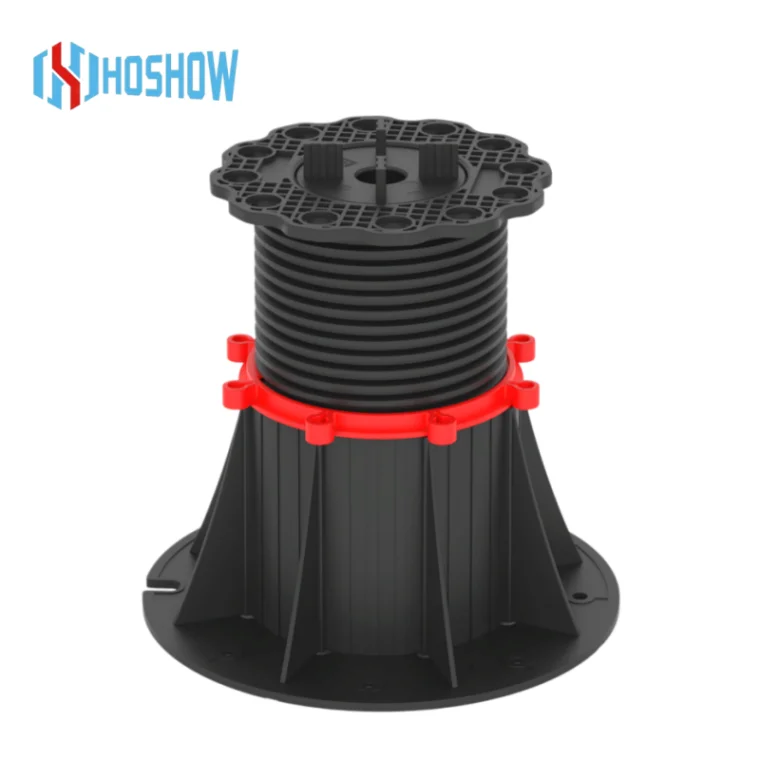
For projects involving stone paving, raised floors, water features, or elevated outdoor spaces, the support system must be selected according to the actual site conditions and structural requirements. A poorly matched pedestal can lead to uneven joints, unstable paving, excessive movement, or costly rework. Understanding the technical characteristics of the system before installation helps create a more predictable construction process and a durable finished surface.
How an Adjustable Pedestal System Works
An adjustable pedestal system consists of support components positioned between the substrate and the finished surface. Depending on the application, the system may include a base, an adjustable threaded body or height-adjustment mechanism, a support head, and accessories such as joist connectors, slope-correction components, or spacer tabs. Together, these components establish the required elevation while maintaining consistent support points beneath the surface.
The primary function is to compensate for differences in the underlying level. On a rooftop terrace, for example, the waterproofed roof may incorporate a designed slope to direct rainwater toward drainage outlets. The paving surface above it generally needs to remain level or follow a specified finished gradient. Adjustable pedestals help reconcile these requirements without creating an unnecessarily thick mortar bed or permanently bonding the paving to the substrate.
The same principle applies to landscape paving and elevated plazas, where the underlying concrete or prepared base may contain local variations. Instead of correcting every irregularity through extensive substrate reconstruction, installers can adjust individual supports within the system's permitted range. This can reduce leveling work and improve access to the space beneath the finished surface.
The system must nevertheless be designed as part of the overall floor or landscape assembly. Pedestals do not replace the need for an adequately designed substrate, waterproofing layer, drainage plan, or structural assessment. Their purpose is to provide controlled support and elevation within a properly engineered construction system.
Load Capacity and Support Spacing
Load-bearing performance is one of the most important considerations when selecting an adjustable pedestal system. The support must withstand the loads transferred from the finished surface while maintaining stability under expected service conditions. These loads may include the weight of paving slabs or decking, people, movable furniture, maintenance equipment, and other application-specific forces.
A pedestal's advertised maximum load capacity should not be treated as the allowable load for every installation. Test conditions, pedestal height, component configuration, support-head design, substrate rigidity, and the distribution of force can all affect actual performance. Higher installations may introduce greater sensitivity to lateral movement, while an uneven or insufficiently rigid base may prevent the support from performing as expected.
Support spacing also matters. Large-format stone slabs, for instance, may require support at corners and additional intermediate points depending on slab dimensions, thickness, material properties, and the manufacturer's installation guidance. A layout suitable for a small, thick paving unit may not be appropriate for a larger or thinner slab. Inadequate support can increase bending stress and create a greater risk of cracking, rocking, or edge damage.
For this reason, the design process should consider the complete assembly rather than evaluating the pedestal in isolation. The load capacity of the finished surface, the number and position of supports, the height of each pedestal, and the properties of the substrate must work together. Where the installation will carry concentrated loads or experience frequent public use, project-specific calculations and verified product test data are particularly important.
Height Adjustment and Installation Accuracy
The height-adjustment mechanism determines how effectively an adjustable pedestal system accommodates site variations. Common designs use threaded adjustment, locking components, or other mechanisms that allow the installer to raise or lower the support to the required elevation. The appropriate adjustment range depends on the finished floor level, substrate variation, drainage design, and available construction depth.
A wide adjustment range can be useful for projects with significant elevation differences, but maximum height alone does not determine suitability. The pedestal must remain stable throughout its operating range, and the adjustment mechanism should allow installers to make accurate corrections without excessive effort. A design that becomes difficult to adjust or secure near its maximum height may slow installation and introduce inconsistencies across the finished surface.
Installation accuracy also depends on repeatability. When numerous pedestals are used across a large terrace or plaza, small differences in height can become visible as uneven joints or changes in surface alignment. A practical system should support consistent adjustment and provide a reliable interface with the selected paving or decking components.
Before installation begins, the construction team should establish reference levels and confirm the required finished elevation. Supports can then be adjusted systematically rather than corrected individually after the surface has been installed. During construction, checking alignment, joint width, support contact, and surface stability helps identify problems before they extend across a larger area.
For elevated installations, the design should also address lateral stability and resistance to displacement. Depending on the project, this may involve compatible locking accessories, perimeter restraints, wind-uplift measures, or other details specified by the system designer. These requirements are especially relevant to exposed rooftops and elevated outdoor spaces.
Material Durability in Outdoor Environments
An adjustable pedestal system used outdoors must withstand moisture, temperature variation, ultraviolet exposure, and repeated loading. Material selection therefore affects both service life and maintenance requirements. Polymer-based supports are commonly used in raised paving applications because they can provide moisture resistance, practical handling characteristics, and compatibility with outdoor construction. However, performance varies according to the material formulation, component geometry, and operating environment.
Cold-weather performance is an important consideration in regions subject to freezing temperatures. Water retained around poorly designed details can freeze and expand, while temperature changes can affect material behavior and the movement of adjoining construction components. A suitable system should be evaluated for its intended temperature range and installation conditions rather than assumed to perform equally well in every climate.
For rooftops and open plazas, exposure to sunlight and prolonged weathering can also influence material durability. Buyers should review available information on UV resistance, temperature limits, long-term load performance, and relevant test methods. Where chemical exposure is possible, such as around certain water features or cleaning operations, material compatibility should also be confirmed.
Durability depends on the entire support assembly. The adjustment mechanism, support head, accessories, and contact surfaces all contribute to performance. A robust main body cannot compensate for poorly fitting accessories or an interface that allows paving units to shift. Evaluating the complete system helps avoid mismatches between components supplied for the same project.
Drainage, Waterproofing, and Maintenance Access
One of the key advantages of an adjustable pedestal system is the space it creates between the finished surface and the substrate. In rooftop gardens and terraces, this cavity can support drainage and provide access to waterproofing layers, drainage outlets, and certain building services, depending on the project design. Individual paving units may be lifted for inspection or repair without removing a permanently bonded surface across a large area.
However, the presence of an open cavity does not guarantee effective drainage. The substrate must have an appropriate drainage gradient, and the layout must avoid obstructing water flow toward outlets. Pedestal bases and other components should be positioned in accordance with the drainage design, particularly near roof drains, expansion joints, and changes in elevation.
Waterproofing protection is equally important. Support bases should be compatible with the roof assembly and installed according to the relevant membrane manufacturer's requirements. Where protective pads or separation layers are specified, they should be selected as part of the complete system rather than added without checking compatibility. Excessive point loading, unsuitable contact materials, or poor installation practices can damage vulnerable waterproofing layers.
Maintenance access should also be considered during planning. A removable paving system can simplify inspection, but access may be limited by edge restraints, fixed furniture, service routes, or other architectural details. Coordinating these features early helps preserve the practical benefits of the elevated construction.
Choosing a System for Different Applications
The best adjustable pedestal system depends on the finished surface and the demands of the project. Stone and porcelain paving installations require support heads compatible with slab dimensions, thickness, joint configuration, and intended loading. Where the design uses timber or composite decking, joist-support accessories may be necessary to connect the pedestal to the supporting battens. Water features and decorative landscape installations may require additional consideration of moisture exposure, elevation control, and the interface between the support structure and the surrounding finish.
Rooftop gardens often prioritize drainage, waterproofing protection, and access for future maintenance. Elevated plazas may place greater emphasis on load distribution, surface stability, and consistent alignment across large areas. Balcony installations can have tighter restrictions on finished height, edge details, and drainage transitions. Indoor decorative floors or exhibition platforms may instead prioritize precise leveling, installation speed, and compatibility with the planned surface materials.
Before specifying a product, confirm the required minimum and maximum height, expected loads, support spacing, adjustment mechanism, material properties, and available accessories. It is also useful to establish whether the project requires slope-correction components, perimeter solutions, or customized support configurations. These details help prevent the common problem of selecting a pedestal based solely on nominal height while overlooking the conditions that determine actual performance.
Why Manufacturer Support Matters
An adjustable pedestal system is most effective when the product specification matches the construction method and site conditions. A capable manufacturer should be able to provide clear technical information on dimensions, adjustment range, load testing, material characteristics, compatible accessories, and installation recommendations. Consistent manufacturing quality is equally important because dimensional variation between supports can increase leveling time and affect the finished surface.
Wuxi Haoxiu Building Materials Technology Co., Ltd. focuses on the research, production, and sales of universal support products, including stone supports, floor supports, keel supports, and water feature supports. Its product range serves applications such as garden landscapes, rooftop gardens, elevated plazas, dry spray landscapes, fountains, balcony decoration, and prefabricated buildings. This application coverage provides a relevant foundation for projects that require different support configurations for paving, decking, and landscape construction.
For projects with specific elevation requirements or non-standard installation conditions, early technical communication can help clarify product compatibility and the information needed for selection. Sharing drawings, finished surface materials, approximate support heights, site conditions, and loading requirements allows the proposed solution to be assessed against the actual construction scenario.
Conclusion
An adjustable pedestal system is more than a leveling accessory. It is a functional part of the elevated surface assembly that influences load transfer, installation accuracy, drainage access, durability, and long-term maintenance. Selecting the right system requires attention to the finished material, support spacing, adjustment range, outdoor exposure, substrate conditions, and the requirements of the complete installation.
For rooftop terraces, landscape paving, balconies, plazas, and decorative water features, a well-matched support system can simplify construction while making the finished surface easier to maintain. By evaluating verified technical data and coordinating the pedestal design with the broader project requirements, contractors can reduce installation risks and achieve a more stable, consistent result. Wuxi Haoxiu Building Materials Technology Co., Ltd. provides universal support products and project-oriented solutions to help meet the varied requirements of elevated flooring and landscape construction.
http://www.hoshowmaterials.com
Wuxi Haoxiu Building Materials Technology Co.,Ltd. -
AuthorPosts

- You must be logged in to reply to this topic.