- This topic is empty.
-
AuthorPosts
-
2026-11-16 at 2:19 pm #15252
A high-quality pickleball paddle racket must balance power, control, impact resistance, weight, and durability without compromising consistency between production batches. For brands and distributors developing paddles for recreational players, competitive users, or private-label markets, these characteristics depend on more than the surface material alone. Core construction, face stiffness, bonding quality, edge protection, handle design, and manufacturing tolerances all influence how a paddle performs during real gameplay.
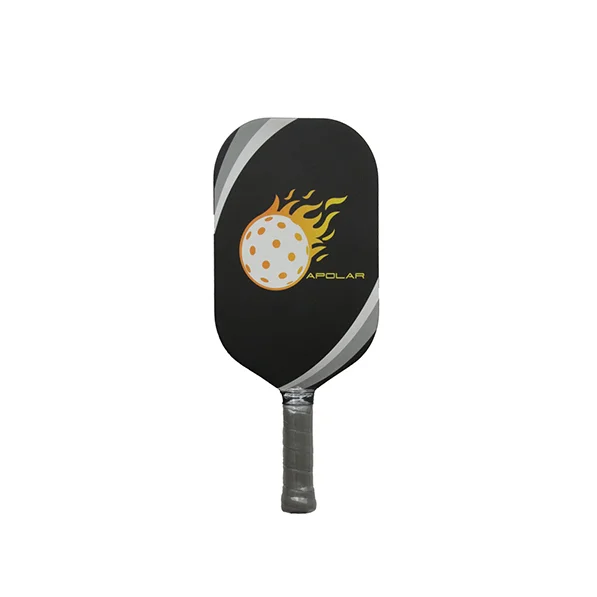
Choosing a suitable manufacturing partner therefore requires an understanding of how material selection and production processes affect the finished product. A paddle designed for controlled dinks and soft-game placement may require a different performance balance from one intended for aggressive drives and powerful overhead shots. The goal is to establish a repeatable construction that matches the target playing style, price point, and durability requirements.
Paddle Face Materials and Their Performance Characteristics
The paddle face directly influences stiffness, surface texture, impact response, and resistance to repeated ball contact. Common face materials include fiberglass composites, carbon fiber composites, and graphite-based constructions. These materials differ in stiffness, weight, cost, and manufacturing requirements, so they should be evaluated as part of the complete paddle structure rather than in isolation.
Fiberglass composite faces are often considered for paddles that need a balance of affordability, impact response, and accessible performance. Their relatively flexible behavior can contribute to a lively feel, depending on the core, face thickness, and bonding structure. This makes fiberglass a practical option for recreational and mid-range product lines, although the finished paddle's actual power and control cannot be predicted from the face material alone.
Carbon fiber composites are frequently selected for performance-oriented paddles because they can provide high stiffness at relatively low weight. Their behavior depends on fiber orientation, resin system, laminate structure, and surface treatment. A carbon face may be designed to support controlled ball placement, fast exchanges at the net, or a firmer response during attacking shots. However, carbon fiber does not automatically guarantee better spin, greater power, or longer service life. Those outcomes depend on the complete design and the quality of execution.
Surface texture is another important consideration. A textured face may help players generate spin, but texture type, depth, consistency, and wear resistance affect how it performs over time. Manufacturers should verify that the intended texture is compatible with the target market's current competition rules if the paddle is being sold for sanctioned play. Approval should not be assumed based solely on the material or surface appearance.
Honeycomb Core Design and Paddle Response
The core occupies much of the paddle's internal structure and plays a major role in impact response, vibration behavior, weight distribution, and overall feel. Polymer honeycomb cores are widely used because they can provide a lightweight structure with distributed support across the paddle face. Other core constructions may be selected depending on the desired stiffness, sound, durability, and cost.
Core thickness, cell geometry, density, and material properties influence how the face responds when the ball strikes different areas of the paddle. A core that is too soft for the intended construction may produce an inconsistent feel or insufficient structural support. A stiffer construction may provide a more direct response but can also alter vibration and impact sensation. These characteristics must be assessed through prototype testing rather than inferred from a single material specification.
The interaction between the core and face is particularly important near the paddle's edges. Impacts away from the center can expose differences in support, stiffness, and energy transfer. A well-developed design should maintain acceptable response across the intended hitting area while resisting core crushing, face separation, and local deformation.
For a new pickleball paddle racket, prototype evaluation should include center hits and off-center impacts, repeated impact cycles, handle stability, and inspection for delamination or structural damage. Testing several core and face combinations can reveal whether a performance change comes from the material itself or from the interaction between layers.
Weight, Balance, and Handle Ergonomics
Paddle weight affects maneuverability, swing speed, stability, and fatigue. A lighter paddle may feel easier to reposition during fast exchanges, while a heavier paddle may provide greater perceived stability on impact. Neither is universally superior. The appropriate target depends on the intended player profile, paddle geometry, core construction, face material, and weight distribution.
Total weight alone is not enough to characterize handling. Two paddles with identical weights may feel substantially different if one concentrates more mass toward the head while the other distributes it closer to the handle. Balance should therefore be evaluated alongside overall mass, grip dimensions, and the paddle's intended use.
The handle also requires careful engineering. Grip circumference, handle length, surface material, and joint strength affect comfort and control. A grip that is too large may restrict wrist movement for some users, while a grip that is too small may require excessive gripping force. Handle geometry should be developed around the intended market and validated through sample evaluation.
The connection between the handle and paddle body is another potential failure point. Repeated impact loads can stress this region, especially when the paddle is used frequently or subjected to accidental impacts. Reinforcement design, bonding quality, and assembly consistency are therefore important to long-term reliability.
Manufacturing Processes and Bonding Quality
Composite paddle manufacturing requires controlled preparation, forming, bonding, trimming, and finishing. Small variations during these stages can affect thickness, weight, surface flatness, edge alignment, and structural integrity. A reliable manufacturer should be able to explain how these variables are controlled from prototype development through volume production.
Face-to-core bonding is particularly critical. Inadequate surface preparation, inconsistent adhesive application, or unsuitable curing conditions can create weak interfaces. These defects may initially remain invisible but develop into separation after repeated impacts or environmental exposure. Appropriate process controls, bonding validation, and inspection criteria help reduce this risk.
Edge guards protect vulnerable paddle edges and can contribute to structural integrity, depending on the design. Their fit, adhesive coverage, and resistance to repeated contact should be checked during development. Poorly fitted guards can create gaps, uneven edges, or premature detachment. Edge finishing should also avoid sharp or irregular transitions that affect handling.
Manufacturing tolerances need to be defined around functional requirements. Paddle weight, overall dimensions, thickness, handle alignment, face flatness, and edge-guard fit should be measured using repeatable methods. Weight variation is especially relevant for product consistency: if units within the same product line feel noticeably different, customers may perceive the range as poorly controlled even when individual paddles remain usable.
Quality Control and Product Validation
Quality control should combine incoming material verification, in-process checks, and finished-product inspection. Face materials and core components should be checked against approved specifications, while production records should help identify material batches and process changes when traceability is required.
Finished paddles can be inspected for weight, dimensions, visual defects, surface consistency, grip installation, and edge protection. More demanding product programs may also require impact testing, bond-strength evaluation, durability testing, and checks for deformation after repeated use. Test methods and acceptance limits should be agreed upon before mass production, with sample sizes appropriate to the product's risk and expected volume.
For paddles intended for tournament use, compliance is a separate requirement from general product quality. The applicable rules and approval process should be confirmed for the target competition market. A paddle should not be marketed as approved for sanctioned play unless its status has been verified through the relevant governing body's current requirements.
Packaging also deserves attention. Composite faces and edge guards can be damaged by abrasion, compression, or poor handling during shipping. Protective packaging should preserve the surface finish and prevent movement inside the carton, particularly for large orders shipped to distributors across North America, Europe, and Southeast Asia.
Choosing a Pickleball Paddle Racket Manufacturer
A suitable manufacturing partner should offer more than assembly capacity. Product development support, composite material experience, mold and tooling management, process consistency, quality inspection, and communication throughout production all influence the final result. The ability to coordinate material selection, prototype trials, production planning, and packaging can reduce handoff problems and improve repeatability.
Established in September 2017, the company described here specializes in the research, development, production, and sales of composite material products. With approximately 70 employees and a factory area of around 4,000 square meters, it serves customers across North America, Europe, Russia, and Southeast Asia. Its broader product portfolio includes sports-related composite products such as beach paddles and other sporting goods, providing a manufacturing background relevant to composite product development.
When evaluating a supplier for a pickleball paddle racket project, it is important to confirm its specific capabilities in paddle construction, face and core bonding, surface finishing, tooling, quality testing, and any required competition approval. Existing composite manufacturing experience is useful, but each new paddle design still needs application-specific validation.
The most effective product development process begins with a clearly defined performance target, followed by material selection, prototype evaluation, and documented production controls. By aligning face materials, core construction, weight distribution, bonding quality, and inspection standards, brands can develop a pickleball paddle racket that delivers consistent playing characteristics while supporting reliable production and long-term market growth.
http://www.ztscarbon.com
APOLAR (DONGGUAN) SPORTS EQUIPMENT CO., LTD. -
AuthorPosts

- You must be logged in to reply to this topic.