- This topic is empty.
-
AuthorPosts
-
2026-11-05 at 4:13 pm #15062
Selecting the right 40mm cabinet door hinge is essential for achieving smooth door movement, stable alignment, and long-term durability in furniture applications. However, the term “40mm” can refer to different dimensions depending on the hinge design, including the cup diameter, mounting geometry, or another specified measurement. Before selecting a hinge, manufacturers and furniture producers should confirm exactly what the 40mm dimension represents, then evaluate door thickness, weight, opening angle, mounting method, and expected operating cycles.
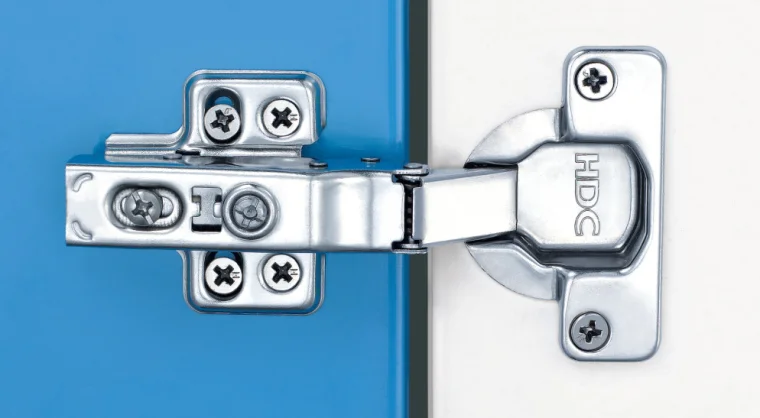
For furniture hardware manufacturers, hinge performance affects more than the movement of an individual door. It influences assembly efficiency, adjustment time, customer experience, and the likelihood of after-sales complaints. Hong Deng Metal Products Co., Ltd. of Nanhai, Foshan, operates under the HDC brand and specializes in researching, manufacturing, and selling furniture hinges and stamping fittings. With a factory covering more than 10,000 square meters, dedicated plating facilities, and equipment including CNC machining centers and automatic plating production lines, the company focuses on combining practical design with manufacturing consistency.
What Does 40mm Mean in a Cabinet Door Hinge?
A dimensional specification should always be interpreted in the context of the hinge structure. In concealed European-style cabinet hinges, the cup diameter is commonly 35mm, while a 40mm dimension may refer to a different cup size, mounting feature, or product-specific measurement. It should not be assumed that every hinge marketed as a 40mm cabinet door hinge has a 40mm cup diameter.
This distinction matters because the cup geometry determines how the hinge fits into the cabinet door. If the cup diameter, depth, or position is incompatible with the door construction, installation may become difficult or compromise the remaining material around the recess. The mounting plate, screw positions, and hinge-arm geometry must also match the cabinet design.
When evaluating a 40mm cabinet door hinge, request a technical drawing that identifies the exact dimension, cup depth, edge distance, mounting-hole spacing, and compatible door thickness. If the hinge is intended to replace an existing component, measuring the original hinge is more reliable than relying on its product name alone.
Door thickness is particularly important. A hinge designed for a thicker solid-wood door may not be suitable for a thin particleboard or MDF panel. The available recess depth, screw engagement, and distance between the cup and the door edge must all be considered to reduce the risk of cracking, screw pullout, or weakened mounting areas.
Load Capacity and Door Weight
Door weight is one of the main factors affecting hinge selection. A large cabinet door made from solid wood, thick MDF, or a decorative composite panel can impose significantly greater loads than a small, lightweight door. Glass inserts, metal trims, and integrated handles may further increase the total mass.
The number of hinges should therefore be determined by door dimensions, weight, material, hinge construction, and the manufacturer's installation guidance. A heavier door may require additional hinges or a stronger hinge model, but adding hinges alone does not automatically resolve an unsuitable mounting arrangement. The cabinet side panel and door material must also be capable of carrying the loads.
For example, a tall pantry door experiences different loading conditions from a short wall-cabinet door. Its greater height increases the potential leverage on the upper and lower mounting points, while repeated opening may introduce additional dynamic loads. In these cases, hinge-arm stiffness, mounting-plate stability, screw retention, and adjustment range become especially important.
A responsible supplier should provide load-related guidance for the specific hinge model and explain the conditions under which any stated capacity or test result applies. Buyers should avoid comparing products solely by a maximum load figure if the test methods, door dimensions, hinge count, and mounting conditions differ.
Opening Angle, Overlay, and Adjustment
The required opening angle depends on how the cabinet will be used. Standard concealed hinges may provide opening angles around 90° to 110°, while selected wide-angle designs offer greater access. The actual range depends on the hinge mechanism, cabinet construction, adjacent doors, internal drawers, and nearby walls.
Overlay is another important design parameter. Full-overlay hinges allow the door to cover most of the cabinet side panel when closed, while half-overlay and inset configurations serve different cabinet layouts. The correct hinge arm and mounting plate combination must be selected according to the door position and cabinet dimensions.
Adjustment capability can significantly reduce installation time. Depending on the model, hinges may support lateral, depth, and height adjustments through the hinge mechanism or mounting plate. These adjustments help correct small variations in drilling, panel dimensions, and cabinet assembly.
However, adjustment should not be used to compensate for major manufacturing errors. If mounting holes are incorrectly positioned or the door is warped, excessive adjustment may leave the hinge operating outside its intended geometry. A consistent drilling pattern and compatible mounting components remain essential for a clean, even door gap.
For furniture manufacturers producing multiple cabinet sizes, selecting a standardized hinge family with compatible mounting plates and adjustment methods can simplify assembly and inventory management. The chosen system should still be verified against the door thickness, overlay requirement, and opening-angle limitations of each cabinet design.
Materials, Surface Treatment, and Corrosion Resistance
Cabinet hinges must withstand repeated mechanical movement while maintaining their appearance. Material selection and surface treatment influence structural strength, wear resistance, and corrosion performance. The appropriate combination depends on the hinge design, installation environment, and expected service life.
Steel is widely used in furniture hinges because it offers practical strength and supports precision forming and machining. Other materials may be suitable for specific hinge components or applications, depending on design requirements. The hinge arm, cup, connecting pins, springs, and mounting plate should be evaluated as parts of a complete mechanism rather than as isolated components.
Surface treatment helps protect metal components against corrosion and improves appearance. Nickel plating and other finishes may be used depending on the product specification. The finish should remain consistent across visible surfaces and should not interfere with moving joints, spring operation, or dimensional fit.
Hong Deng Metal Products Co., Ltd. operates dedicated plating facilities and reports that its products have passed a 48-hour salt-spray test, alongside opening-and-closing testing exceeding 80,000 cycles and national product quality testing under QB/T 2189-1995. These results provide useful reference points when assessing durability, but the exact test report, applicable product model, test conditions, and current standard requirements should be confirmed for the hinge being purchased.
Salt-spray performance and mechanical endurance measure different properties. A hinge that performs well in a corrosion test may still require separate verification of load capacity, adjustment stability, and wear under repeated operation. For coastal properties, humid interiors, or furniture exposed to cleaning chemicals, the required finish and corrosion protection should be specified according to the actual environment.
Manufacturing Precision and Quality Control
Hinge reliability depends on repeatable dimensions and consistent assembly. Variations in cup geometry, arm alignment, pin fit, spring force, or mounting-hole position can affect door movement and final alignment. Even small deviations may become noticeable when multiple cabinet doors are installed side by side.
CNC machining, controlled stamping, and stable production processes help manufacturers maintain repeatability across batches. Automated plating can also support more consistent surface treatment when process parameters and inspection procedures are properly controlled.
For OEM projects, technical documentation should define critical dimensions, material requirements, finish, functional tolerances, and acceptance criteria. Samples should be evaluated on the actual cabinet construction rather than only on a standalone test fixture. This helps identify problems related to screw retention, panel thickness, door gaps, or interference with adjacent components before mass production begins.
Choosing a Reliable 40mm Cabinet Door Hinge Supplier
The best 40mm cabinet door hinge is not necessarily the one with the lowest unit price. Its value depends on dimensional compatibility, mechanical durability, surface quality, installation efficiency, and consistency across production batches.
HDC's manufacturing capabilities include CNC equipment, line-cutting machinery, automatic production equipment, and dedicated plating facilities. When evaluating a model for a furniture project, confirm the exact meaning of the 40mm dimension, door compatibility, opening angle, overlay configuration, load-related guidance, adjustment range, and available quality documentation.
A complete specification and sample validation process can reduce installation issues and improve finished furniture quality. By treating the hinge as a precision mechanical component rather than a generic accessory, furniture manufacturers can achieve more consistent door alignment, smoother operation, and more reliable performance throughout the product's service life.
http://www.hdcprec.com
Hong Deng metal products Co., LTD -
AuthorPosts

- You must be logged in to reply to this topic.