- This topic is empty.
-
AuthorPosts
-
2026-11-25 at 5:36 pm #15385
Why Conveyor Operations Need Distance-Based Laser Object Detection
Industrial conveyor systems depend on accurate, real-time knowledge of where objects are, how far they sit from a reference point, and whether their position is changing. Traditional approaches to this problem often rely on manual measurement or on conventional photoelectric sensors that only report presence or absence rather than continuous distance data. Contact-based measurement methods introduce mechanical wear over time, and on real production floors, variations in target color, material, gloss, inclination, and ambient lighting can destabilize detection results. These limitations raise commissioning effort, complicate troubleshooting, and increase long-term maintenance costs — issues that are especially visible on fast-moving conveyor lines where missed or false detections directly affect throughput.
KJT Sensors addresses this gap with a portfolio of non-contact laser and time-of-flight (ToF) sensing products built specifically for industrial automation environments, including the distance detection, position determination, and object identification tasks found on conveyor and sorting lines.
Non-Contact Laser Distance Sensing: The Core Technology
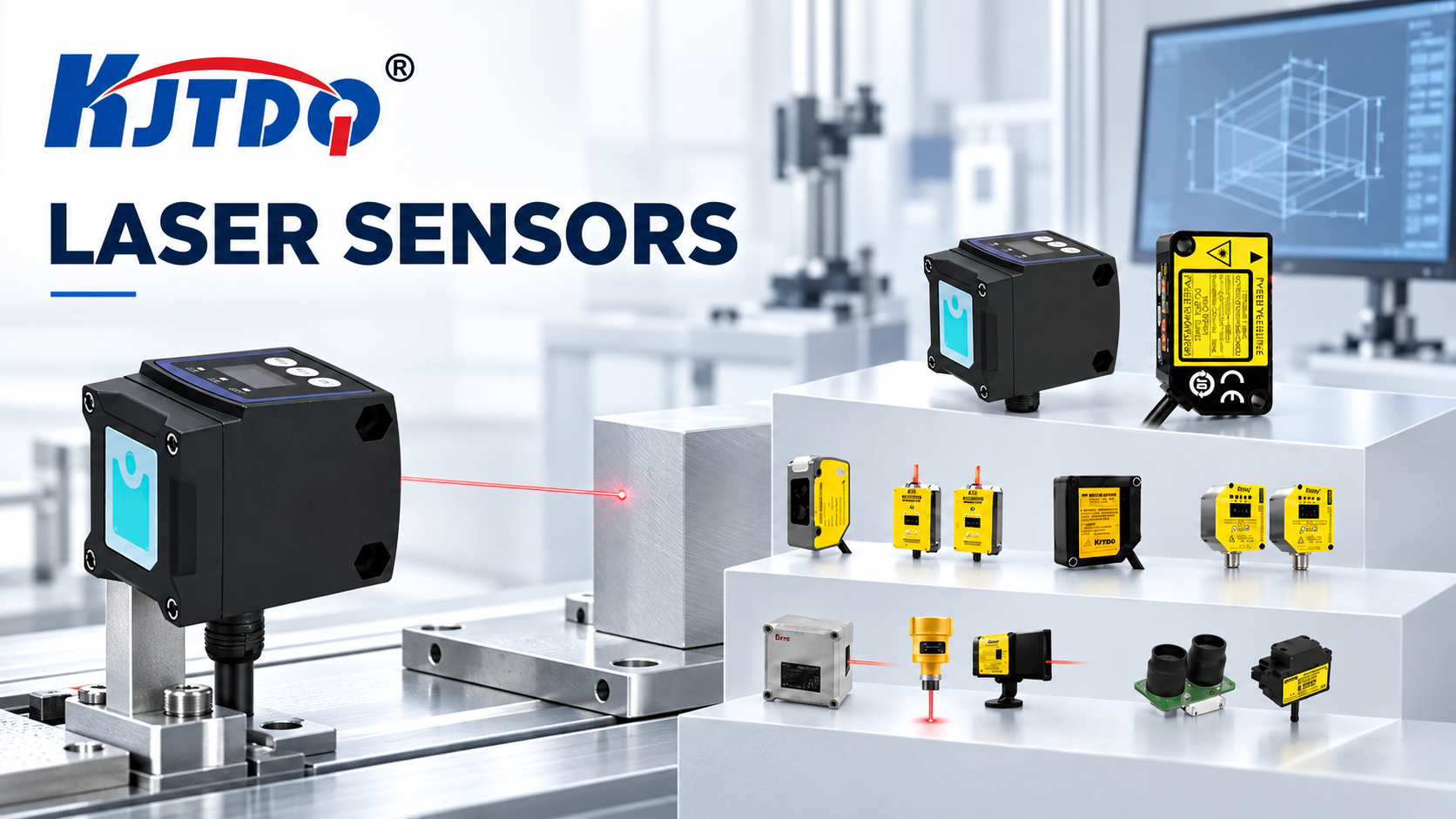
At the center of KJT Sensors’ approach is non-contact laser ranging. The company’s laser distance sensors detect vertical or inclined targets at distances of up to 30 meters without any physical contact with the object being measured. This matters directly for conveyor applications, where parts, packages, or bulk materials move continuously and cannot be measured by hand or by contact probes without interrupting the process.
A key differentiator is reduced sensitivity to target surface characteristics. Because conveyor-borne objects vary widely in color, material, gloss, and orientation, sensors that depend heavily on reflected light intensity can produce unstable readings. KJT Sensors’ laser distance and laser displacement sensors are designed to reduce these effects, helping maintain stable distance readings even as object types change from one unit to the next on the same line.
For harsh production environments, these sensors carry IP67 enclosure protection and are built with strong ambient-light immunity, allowing them to maintain stable operation under dust, moisture, and variable lighting conditions common on factory floors and in outdoor loading areas.
Time-of-Flight Photoelectric Sensors for High-Speed Lines
Conveyor-specific detection often requires more than long-range measurement; it requires speed. KJT Sensors’ ToF laser photoelectric sensors calculate distance from the travel time of the emitted signal rather than relying solely on reflected light intensity. This time-of-flight methodology supports stable detection of complex surfaces, transparent objects, and long-distance targets — scenarios where conventional photoelectric switches are historically less reliable.
For high-speed production and conveyor lines, switching frequency reaches up to 1,000 Hz, with an adjustable response time of 1 millisecond, reducing the risk of missed detections as objects pass quickly through the sensing zone. The KJT-FG40 series offers sensing distances of 1 meter, 2 meters, and 4 meters, giving integrators flexibility to match sensor range to conveyor width or object spacing. These sensors also resist sunlight interference, which supports consistent performance in outdoor-channel detection and loading-dock applications where ambient light fluctuates throughout the day.
Flexible Signal Outputs for System Integration
A recurring theme across KJT Sensors’ product line is output flexibility. Depending on the model, available interfaces include relay limit output, NPN/PNP output, analog voltage, analog current, 4–20 mA, and RS-485. This range of options allows conveyor control systems to connect sensors directly to PLCs, control cabinets, supervisory computers, data-acquisition systems, or safety-monitoring systems without extensive rework of existing control architecture.
For teams managing in-position detection on automated production lines, this means a single sensor family can support both simple switching logic and continuous distance feedback for closed-loop control, depending on which output is selected at the time of configuration.
On-Site Commissioning and Diagnostics
Field commissioning and troubleshooting are common pain points in industrial sensor deployment, particularly when sensors must be reconfigured for different object types or line layouts. KJT Sensors’ relevant laser distance and ToF products include display and pushbutton programming — some with OLED displays — enabling installation teams to view real-time distance readings, set thresholds, adjust parameters, and diagnose faults directly at the sensor, without needing to return to a central control panel for every adjustment. This on-site diagnostic capability reduces the time required to bring a conveyor line back into stable operation after a fault or product changeover.
Conveyor and Logistics Applications
The industry adaptation documented for KJT Sensors’ product range includes several scenarios directly relevant to conveyor-based object detection: logistics sorting and package inspection, in-position detection on automated production lines, production-line counting, bottle-cap and label in-position detection, smart warehouse goods-in-position detection, and electronic-component in-position detection. The same non-contact distance sensing principles also extend to adjacent use cases such as crane collision avoidance, stacker crane and shuttle positioning, and AGV/AMR obstacle avoidance — all of which share the same underlying requirement for continuous, reliable distance data rather than simple on/off signals.
Beyond detection alone, KJT Sensors’ measurement-oriented sensors support quality-related tasks that often sit alongside conveyor detection, including thickness measurement, flatness inspection, and surface-profile measurement, with data output to PLCs, controllers, or supervisory computers for automatic decision-making and closed-loop control.
A Practical Path from Quotation to Deployment
KJT Sensors structures its delivery model around the complexity of the application. Standard models can be quoted quickly once the model and quantity are identified, while projects involving special operating conditions, non-standard customization, or volume purchases go through technical confirmation based on site environment, mounting method, detection object, required output signal, and system access requirements. This approach is intended to match sensor selection to the realities of each conveyor or production line rather than applying a one-size-fits-all configuration.
Conclusion
For teams evaluating distance-based laser object detection on conveyors, the combination of long-range non-contact measurement, high-speed ToF sensing, flexible output interfaces, IP67 protection, and on-site programmability positions KJT Sensors as a practical option for industrial automation, logistics, packaging, food and beverage, and equipment manufacturing environments where stable, continuous distance data is required to keep conveyor operations running smoothly.
https://www.kjt-sensors.com/
KJT Sensors -
AuthorPosts

- You must be logged in to reply to this topic.