- This topic is empty.
-
AuthorPosts
-
2026-06-22 at 2:33 pm #13410
In modern industrial processing, homogenization plays a critical role in ensuring product stability, consistency, and performance. Whether in food production, pharmaceuticals, cosmetics, or biotechnology, achieving uniform particle size and stable emulsions is essential.
Two of the most widely used technologies for this purpose are the High-Pressure Homogenizer and the Ultrasonic Homogenizer. While both are designed to break down particles and improve mixture uniformity, they operate on completely different physical principles and are suited for different applications.
This article provides a detailed, original comparison between these two technologies, helping you understand how they work, where they excel, and how to choose the right system for your process.
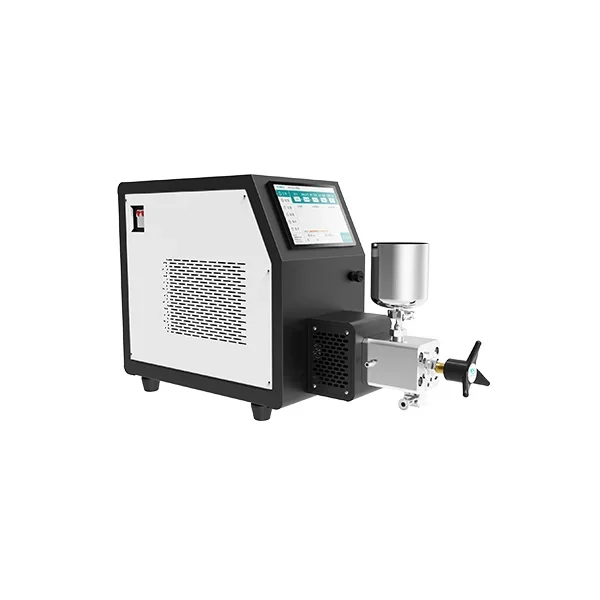
1. What Is a High-Pressure Homogenizer?
A High-Pressure Homogenizer is an industrial device that reduces particle size and creates stable emulsions by forcing fluid through a narrow valve or orifice at extremely high pressure—often ranging from 100 to over 1500 bar.
Working Principle
The process typically involves three main physical forces:
-
High shear force
-
Cavitation
-
Impact and turbulence
When the fluid passes through the narrow gap at high velocity, intense pressure drop occurs, causing particles to break apart and disperse evenly.
This method is widely used in large-scale production environments where consistency and throughput are essential.
2. What Is an Ultrasonic Homogenizer?
An Ultrasonic Homogenizer, also known as a sonicator, uses high-frequency sound waves (typically 20–40 kHz) to generate cavitation bubbles in a liquid medium.
Working Principle
The ultrasonic probe (or horn) creates rapid pressure changes in the liquid, forming microscopic bubbles. These bubbles collapse violently, producing:
-
Shock waves
-
Microjets
-
Localized high temperature and pressure
This phenomenon breaks particles, cells, or droplets into smaller sizes.
Ultrasonic homogenizers are often used in laboratory-scale applications and small-batch processing.
3. Key Difference in Operating Mechanism
The most fundamental difference lies in how energy is delivered:
High-Pressure Homogenizer
-
Uses mechanical pressure
-
Forces fluid through a narrow valve
-
Relies on controlled high-energy fluid dynamics
Ultrasonic Homogenizer
-
Uses acoustic energy (sound waves)
-
Generates cavitation through vibration
-
Energy is localized around the probe tip
In simple terms:
-
High-pressure homogenizers use flow-based mechanical force
-
Ultrasonic homogenizers use wave-induced cavitation
4. Particle Size Reduction Capability
Both systems can reduce particle size, but their efficiency and consistency differ.
High-Pressure Homogenizer
-
Can achieve particle sizes as low as 100 nm or below
-
Produces highly uniform emulsions
-
Ideal for nanoemulsions and industrial-grade dispersion
Ultrasonic Homogenizer
-
Typically achieves micrometer to sub-micrometer range
-
Nanoparticle formation is possible but less consistent
-
Better suited for small-scale or experimental work
5. Scalability and Production Capacity
High-Pressure Homogenizer: Industrial-Grade Scalability
This system is designed for continuous operation and large-scale production. It can handle:
-
Thousands of liters per hour
-
Continuous processing lines
-
Industrial food and pharmaceutical manufacturing
Ultrasonic Homogenizer: Limited Scale
Ultrasonic systems are generally:
-
Batch-based
-
Limited in volume capacity
-
More suitable for laboratory or pilot-scale use
If your production requires high throughput, high-pressure systems are the preferred choice.
6. Energy Efficiency and Heat Generation
High-Pressure Homogenizer
-
Energy is distributed through fluid flow
-
Heat generation is moderate and can be controlled with cooling systems
-
More efficient at large scale
Ultrasonic Homogenizer
-
Energy is concentrated at the probe tip
-
Generates significant localized heat
-
Cooling or pulsed operation is often required for temperature-sensitive materials
7. Application Areas
High-Pressure Homogenizer Applications
-
Dairy processing (milk, yogurt, cream)
-
Beverage emulsification
-
Pharmaceutical emulsions and liposomes
-
Nanoemulsion production
-
Protein and enzyme processing
-
Cosmetic emulsions (creams, lotions)
Ultrasonic Homogenizer Applications
-
Cell disruption in biotechnology
-
DNA/RNA extraction
-
Laboratory sample preparation
-
Small-scale emulsification
-
Nanoparticle research
-
Chemical synthesis experiments
8. Product Consistency and Quality
High-Pressure Homogenizer
-
Produces highly uniform particle distribution
-
Excellent reproducibility in industrial batches
-
Stable long-term emulsions
Ultrasonic Homogenizer
-
More variability between batches
-
Sensitive to operator technique and probe positioning
-
Best for research-level precision rather than industrial consistency
9. Maintenance and Equipment Durability
High-Pressure Homogenizer
-
Built for long-term industrial use
-
Requires valve maintenance and seal replacement
-
High initial investment but long operational lifespan
Ultrasonic Homogenizer
-
Probe wear is common
-
Requires frequent replacement of sonotrodes in heavy use
-
Lower maintenance complexity but shorter lifespan in continuous operation
10. Cost Considerations
High-Pressure Homogenizer
-
High upfront investment
-
Lower cost per unit output at scale
-
Economical for mass production
Ultrasonic Homogenizer
-
Lower initial cost
-
Higher cost per unit for large-scale production
-
Ideal for R&D budgets and small labs
11. Advantages and Limitations
High-Pressure Homogenizer
Advantages:
-
Excellent scalability
-
High efficiency in industrial production
-
Produces stable nanoemulsions
-
Suitable for continuous processing
Limitations:
-
High capital cost
-
Requires complex maintenance
-
Larger physical footprint
Ultrasonic Homogenizer
Advantages:
-
Simple setup
-
Flexible for lab experiments
-
Effective for cell disruption
-
Lower purchase cost
Limitations:
-
Limited scale
-
Heat generation issues
-
Less uniformity in large batches
12. Which One Should You Choose?
The choice between a High-Pressure Homogenizer and an Ultrasonic Homogenizer depends on your application requirements.
Choose High-Pressure Homogenizer if you need:
-
Industrial-scale production
-
Consistent large-batch emulsification
-
Nanoemulsion manufacturing
-
Pharmaceutical or food-grade processing
Choose Ultrasonic Homogenizer if you need:
-
Laboratory research
-
Small batch processing
-
Cell lysis or molecular extraction
-
Experimental formulation development
13. Future Trends in Homogenization Technology
As industries evolve, both technologies are improving:
-
High-pressure systems are becoming more energy-efficient and automated
-
Ultrasonic systems are integrating digital control and precision tuning
-
Hybrid systems combining both technologies are emerging in advanced R&D environments
In the future, we may see integrated homogenization platforms that combine pressure-based and acoustic-based mechanisms for optimized performance.
Conclusion
The comparison between High-Pressure Homogenizer and Ultrasonic Homogenizer is not about which is better overall, but which is better for a specific purpose.
-
High-pressure homogenizers dominate industrial-scale manufacturing with superior consistency and throughput.
-
Ultrasonic homogenizers excel in laboratory environments and small-scale applications where flexibility is key.
Understanding these differences helps engineers, researchers, and manufacturers select the right technology to optimize product quality, efficiency, and cost-effectiveness.
http://www.dscientz.com
dscientz -
-
AuthorPosts

- You must be logged in to reply to this topic.