- This topic is empty.
-
AuthorPosts
-
2026-11-16 at 2:14 pm #15237
A pulley profile is a critical design feature in belt-driven transmission systems, directly affecting belt engagement, torque transmission, positioning accuracy, operating noise, and service life. In applications such as automated production lines, packaging machinery, CNC equipment, and industrial robotics, selecting the correct pulley profile is essential to achieving stable transmission performance. Even when a pulley has the correct outer diameter and tooth count, an incompatible tooth geometry can lead to poor belt engagement, uneven load distribution, premature wear, or positioning errors.
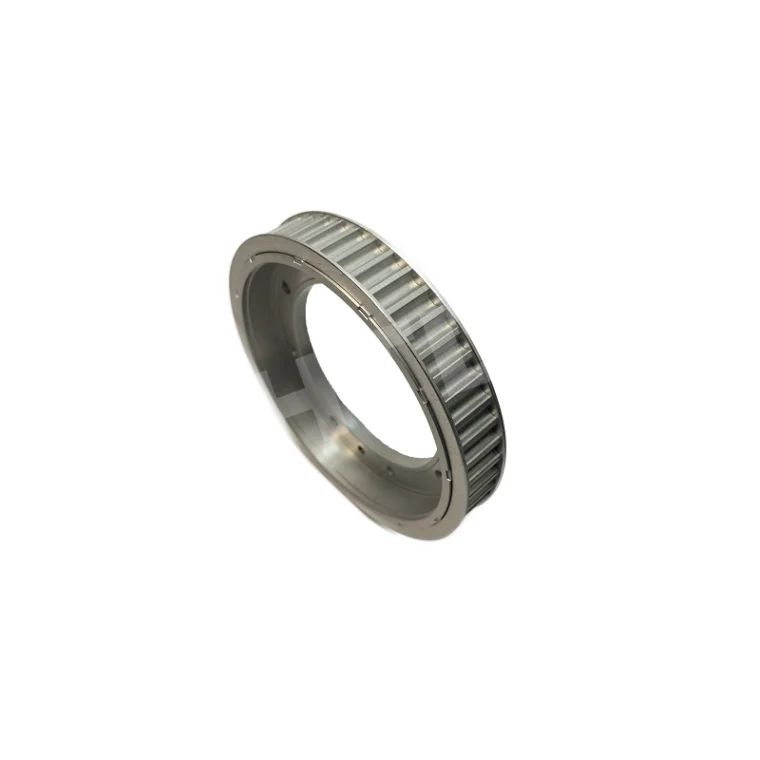
For manufacturers developing precision drive systems, pulley profile selection should begin with the belt specification, operating conditions, and transmission requirements rather than dimensions alone. Hetuoda Machinery Manufacturing specializes in precision transmission components, including timing belt pulleys, toothed plates, tensioning pulleys, gears, and custom-machined parts. With OEM manufacturing capabilities, the company supports application-specific component development where dimensional consistency, tooth geometry, and production repeatability are essential.
What Is a Pulley Profile and Why Does It Matter?
A pulley profile refers to the geometry of the belt-contacting surface, particularly the shape, pitch, depth, and spacing of the teeth in a toothed timing belt pulley. In a synchronous drive system, the pulley profile must correspond to the belt's tooth geometry to establish correct engagement and maintain synchronization between the driving and driven shafts.
Different timing belt systems use different tooth profiles. Common examples include trapezoidal profiles such as MXL, XL, L, and T-series profiles, as well as curvilinear profiles such as HTD and GT-series designs. These profiles are not interchangeable simply because their nominal dimensions appear similar. Differences in tooth shape and contact geometry affect how loads transfer from the belt to the pulley and how the system behaves under acceleration, deceleration, and fluctuating torque.
A trapezoidal tooth profile generally uses straight or nearly straight tooth flanks, while curvilinear profiles use rounded tooth geometry designed to improve engagement characteristics under suitable operating conditions. The actual performance depends on the complete belt-and-pulley combination, including materials, tooth dimensions, belt construction, and installation conditions.
For example, a conveyor system operating at moderate speed with relatively steady torque may have different requirements from a robotic axis that repeatedly accelerates, stops, and reverses direction. The latter places greater emphasis on backlash-related motion errors, tooth engagement stability, and consistent manufacturing accuracy. Choosing the appropriate pulley profile helps establish the foundation for meeting these requirements.
Common Pulley Profiles and Their Applications
The most suitable pulley profile depends on the belt family and the demands of the transmission system. Understanding the differences between common profiles helps prevent specification errors during mechanical design and component sourcing.
Trapezoidal timing belt profiles are widely used in general-purpose power transmission and positioning applications. Profiles such as XL and L are commonly associated with inch-based timing belt systems, while T-series profiles use metric pitch designations. Their suitability depends on the required load capacity, pulley diameter, belt dimensions, and operating speed. When specifying these profiles, the exact belt series must be confirmed because similar-looking tooth geometries may have different pitch and engagement requirements.
HTD pulley profiles use rounded tooth geometry and are commonly found in industrial power transmission applications. HTD systems are available in different pitches, including 3M, 5M, 8M, and 14M. Smaller pitches are often considered for compact mechanisms, while larger pitches may be appropriate for higher-load applications when the belt, pulley size, and system design support the required torque. Pitch alone, however, does not determine load capacity.
GT and other high-performance curvilinear profiles are used in applications requiring precise belt engagement and controlled motion. Depending on the specific belt design, these profiles may be suitable for automation equipment, positioning stages, and other motion-control systems. Their performance relies on matching the intended belt and pulley geometry rather than substituting a pulley based solely on nominal pitch.
The following table provides a practical starting point for evaluating pulley profile options.
Profile family
Typical application focus
Key specification concern
MXL, XL, L
General-purpose synchronous drives
Belt series, pitch, and tooth geometry
T-series
Metric-pitch transmission systems
Exact T-series designation and compatibility
HTD 3M, 5M, 8M, 14M
Industrial power transmission
Torque, pitch, pulley diameter, and belt capacity
GT-series
Precision motion and positioning
Matching the designated belt and pulley system
Custom tooth profile
Specialized or legacy equipment
Original drawings, dimensional inspection, and validation
These categories are not universal performance rankings. The correct selection must be based on the intended belt system and actual operating conditions. Where a machine uses a proprietary, legacy, or nonstandard belt, the original profile drawing or a verified reference component may be necessary to establish the correct geometry.
How to Select a Pulley Profile for Your Application
Pulley profile selection requires more than identifying the nominal belt pitch. A technically sound specification should account for load, speed, positioning requirements, installation constraints, and the intended service environment.
Start With the Exact Timing Belt Specification
The belt manufacturer's designation is usually the most reliable starting point. Record the belt series, pitch, tooth geometry, width, and relevant dimensional tolerances. For example, a designation such as HTD 5M identifies a particular profile family and nominal pitch, but it does not fully define the pulley. The required tooth count, belt width, mounting arrangement, and dimensional tolerances must also be established.
When replacing an existing pulley, do not assume that a visual match guarantees compatibility. Two pulleys can have similar outside diameters while using different tooth profiles. A mismatch can concentrate contact loads, prevent proper seating, or cause abnormal wear. For custom replacements, verify the belt specification against engineering drawings or manufacturer documentation before releasing the part for production.
Evaluate Torque, Speed, and Load Variation
A pulley profile must operate within the limits of the complete transmission system. Continuous torque, peak torque, acceleration, braking, and load reversals all influence belt engagement and component life. A drive that runs steadily may behave differently from a servo-driven mechanism exposed to frequent start-stop cycles.
The required pulley size and tooth count also affect the design. Smaller pulleys can reduce packaging space, but they may increase belt bending severity and place additional demands on the belt construction. Larger pulleys may improve belt bending conditions but require more installation space and can increase rotating inertia.
Profile selection should therefore be evaluated alongside the belt's rated power or torque capacity, minimum recommended pulley diameter, shaft arrangement, and expected duty cycle. If the application involves high acceleration, shock loading, or repeated reversals, the system should be checked for belt tooth loading, tension stability, and motion accuracy rather than relying on profile selection alone.
Consider Positioning Accuracy and Backlash-Related Errors
In automated equipment, pulley profile accuracy can influence repeatability and synchronization. Tooth geometry determines how the belt engages with the pulley, while manufacturing tolerances, belt elasticity, tooth clearance, shaft alignment, and tension contribute to overall motion behavior.
For example, a positioning axis in a pick-and-place machine may need to maintain consistent movement across thousands of operating cycles. An incorrectly matched pulley profile can introduce uneven engagement and variation in transmission behavior. However, selecting a precision profile does not automatically eliminate positioning error. Belt stretch, shaft deflection, mounting eccentricity, and control-system settings must also be considered.
Where repeatability is critical, define measurable requirements such as allowable radial runout, pitch-related dimensional variation, tooth profile tolerance, and assembled-system positioning error. These requirements should reflect the machine's actual performance needs and the capabilities of the inspection process.
Match the Pulley Material and Manufacturing Method
The pulley profile defines the belt-contacting geometry, but the pulley material and manufacturing method determine whether that geometry can be produced consistently and maintained under operating loads.
Aluminum pulleys are commonly considered for applications where low rotating mass and reduced inertia are important. Steel pulleys may be suitable for applications requiring greater strength, stiffness, or resistance to demanding operating conditions. Other materials may be appropriate depending on corrosion exposure, weight constraints, and the mechanical design. The final choice must account for the required torque, tooth loading, shaft interface, and operating environment.
Manufacturing methods also matter. CNC machining can support controlled dimensional production for custom pulleys and specialized geometries, while suitable production methods for larger quantities depend on part complexity, material, and required tolerances. Regardless of the process, consistent tooth geometry, concentricity, bore accuracy, and surface condition are important to reliable assembly and transmission performance.
Pulley Profile Accuracy: Which Dimensions Should Be Controlled?
A pulley may satisfy its nominal outside diameter and tooth count yet still fail to deliver the required performance if critical dimensions are not controlled. For precision transmission components, inspection should focus on the features that determine belt engagement and shaft alignment.
Tooth pitch and tooth profile are central because they govern the relationship between the belt and pulley. The bore diameter and its tolerance determine how the pulley fits on the shaft, while concentricity and radial runout influence rotational consistency. Face width must accommodate the specified belt width and any required alignment clearance. Keyways, threaded holes, flanges, and other mounting features must also conform to the assembly drawing.
For example, a pulley used in a compact automated machine may require a close-fitting bore and controlled runout to support stable rotation. A pulley used in a general-purpose conveyor may place greater emphasis on load capacity, mounting durability, and consistent production dimensions. Both applications need appropriate quality control, but the inspection priorities may differ.
A practical quality-control process should include dimensional inspection of critical features, verification of tooth geometry against the specified profile, and checks of mounting interfaces. Depending on the part and application, additional controls may include material verification, surface-finish inspection, hardness testing, and first-article inspection. Measurement methods and acceptance criteria should be agreed upon before mass production, particularly for custom OEM components.
Common Pulley Profile Selection Mistakes
One frequent mistake is selecting a pulley by outside diameter alone. Although outside diameter is useful for checking packaging constraints, it does not establish compatibility with the belt. Tooth profile, pitch, tooth count, and the effective pitch geometry must also match.
Another issue is treating different profiles with the same nominal pitch as interchangeable. A rounded tooth profile and a trapezoidal profile can have different engagement characteristics even when their nominal dimensions appear comparable. Using the wrong profile can lead to poor contact, noise, accelerated wear, or transmission instability.
Manufacturing tolerances are another source of problems. A pulley with inconsistent tooth dimensions or excessive runout can compromise an otherwise correctly designed drive. These issues become more noticeable in systems with tight positioning requirements, higher operating speeds, or frequent changes in direction.
Finally, replacing a pulley without checking the entire drive system can lead to repeated failures. Belt tension, shaft alignment, pulley spacing, mounting rigidity, and the operating environment all affect performance. A reliable replacement process verifies these factors instead of treating the pulley as an isolated component.
OEM Pulley Profile Manufacturing for Custom Drive Systems
Standard pulley profiles cover many industrial applications, but specialized machinery may require custom tooth counts, bore dimensions, keyways, flange configurations, materials, or mounting interfaces. In these situations, OEM manufacturing provides a way to align the component with the actual mechanical design rather than forcing the design to accommodate an unsuitable standard part.
Hetuoda Machinery Manufacturing produces precision transmission components, including timing belt pulleys, toothed plates, tensioning pulleys and related machined parts, with OEM services for application-specific requirements. When developing a custom pulley profile, the process should begin with clear technical documentation, including belt specifications, engineering drawings, material requirements, dimensional tolerances, and expected operating conditions.
For new projects, supplying the intended belt model and transmission parameters helps establish the correct profile and supporting dimensions. For replacement projects, original drawings, verified samples, or detailed measurements can help identify the required geometry. Before volume production, confirming critical dimensions and completing an agreed first-article inspection can reduce the risk of compatibility problems during assembly.
A technically complete RFQ should specify the pulley profile and belt series, pitch, tooth count, belt width, bore and keyway dimensions, material, surface treatment if required, tolerances, quantity, and inspection expectations. Where operating loads or motion accuracy are demanding, include the relevant torque, speed, duty cycle, and environmental conditions. These details give the manufacturer a clearer basis for evaluating feasibility, production consistency, and quality requirements.
Conclusion
Choosing the right pulley profile is a fundamental step in designing a reliable synchronous drive system. Belt compatibility, tooth geometry, torque requirements, operating speed, positioning accuracy, material selection, and manufacturing tolerances must be considered together. A profile that works well in a general-purpose conveyor may not be the appropriate choice for a high-cycle automation axis, even when both systems use toothed belts.
For standard and custom transmission applications, accurate specifications and controlled manufacturing are essential to achieving consistent engagement and dependable service life. By combining verified belt requirements with appropriate dimensional controls and OEM machining capabilities, Hetuoda Machinery Manufacturing supports the development of pulley components suited to the mechanical and operational demands of different drive systems.
http://www.cdepulley.com
Suzhou Hetuoda Machinery Manufacturing Co., Ltd. -
AuthorPosts

- You must be logged in to reply to this topic.