- This topic is empty.
-
AuthorPosts
-
2026-10-28 at 8:48 pm #14952
A professional automated coffee service must deliver more than a cup of coffee. For businesses, institutions, and investors, the right solution needs to combine consistent beverage preparation, reliable equipment, efficient operations, and a service model that can adapt to different locations and customer demands.
Shanghai Hi-Dolphin Robot Technology Co., Ltd., the developer of COFE+, has built its robotic café portfolio around these requirements. Its product range includes the COFE+ Robot Coffee Kiosk, COFE+ Robot Coffee Counter, COFE+ Robot Coffee Bar, and COFE+ Corner Robot Coffee Shop. These AI-powered systems integrate robotic beverage preparation with intelligent operations management to support automated coffee retail in commercial and institutional environments.
With a product development history beginning in 2017 and a seventh-generation robotic café launched in 2026, COFE+ represents an evolving approach to automated beverage service. The company’s focus is to help operators expand access to freshly prepared drinks while addressing staffing challenges, space constraints, and the complexity of managing multiple retail locations.
Why Businesses Need a Professional Automated Coffee Service
Traditional coffee shops often require two to five employees per shift and approximately 30 to 100 square meters of commercial space, depending on the format. Recruitment, training, employee turnover, rent, and daily operating expenses can make it difficult to maintain consistent service and expand profitably.
Conventional vending machines offer an alternative, but many systems rely on instant powder or simplified preparation processes. These approaches may not satisfy customers seeking freshly ground beans, milk-based beverages, customizable recipes, and café-style presentation.
A professional automated coffee service bridges this gap by combining automated preparation with a broader beverage menu and centralized operational controls.
For hospitals, airports, universities, office buildings, hotels, and transportation hubs, robotic cafés can also extend service availability beyond conventional retail hours. Depending on the installation and operating arrangements, a unit may serve customers around the clock without requiring a dedicated barista to prepare every order.
COFE+ approaches this opportunity through compact, self-contained robotic cafés designed for different space and business requirements. Rather than reproducing a conventional café in miniature, the model integrates beverage preparation, ingredient management, and selected service functions into an automated retail system.
Core Technology Behind COFE+ Robotic Cafés
Robotic Beverage Preparation and Customization
COFE+ robotic cafés use precision robotic systems to execute defined beverage preparation workflows. Selected configurations incorporate six-axis robotic arms, while the exact hardware and capabilities vary across product generations and models.
Depending on the configuration, automated workflows can include fresh-bean grinding, espresso preparation, ingredient dispensing, cup handling, and beverage delivery. Selected models also support latte art or the printing of images and text on milk foam.
The company reports that certain configurations can coordinate the preparation of up to five cups and achieve typical preparation times of approximately 50 to 55 seconds per cup under specified conditions. Actual throughput depends on the recipe, order complexity, equipment configuration, and operating environment.
COFE+ systems are designed to offer more flexibility than conventional vending machines. Selected configurations support two to four milk types, six to eight syrup options, and up to 7 topping choices. These ingredients can be combined to create a broad range of customizable beverages.
Available options vary by model and menu, but may include espresso-based coffee, milk coffee, tea, chocolate, and hot or iced drinks. The company’s seventh-generation robotic café further expands its stated menu capabilities to more than 300 beverages across eight categories, with thousands of potential taste customizations.
For operators, the practical value of this flexibility is the ability to adapt menus to different customer groups, local preferences, and commercial settings without relying entirely on manual preparation.
Smart Store Brain: Intelligent Operations Management
Reliable automated coffee service depends on more than robotics. Operators also need to understand what each machine is doing, when ingredients need replenishing, and whether technical issues require intervention.
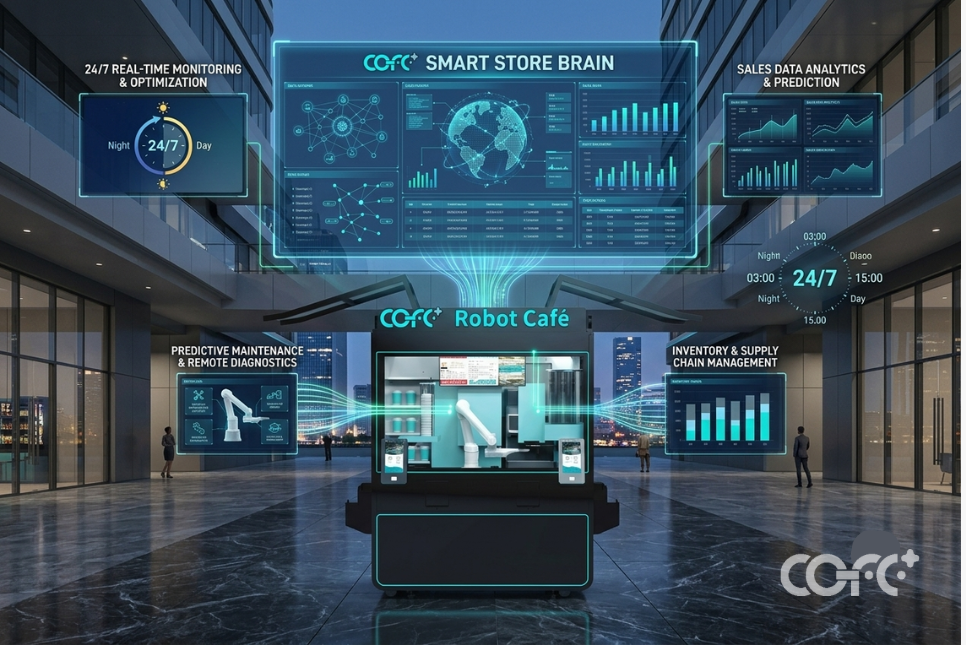
COFE+ addresses these needs through its proprietary Smart Store Brain, an AIoT-based management platform designed to connect deployed equipment with centralized operational systems.
Depending on the configuration, the platform supports remote monitoring of sales, ingredient inventory, machine status, operational alerts, and diagnostic information. This enables operators to oversee equipment remotely, identify replenishment requirements, and respond to selected technical issues without making a site visit for every routine check.
The company has also reported that its remote diagnosis and repair capabilities can resolve a substantial proportion of service issues remotely. Actual results depend on connectivity, fault type, spare-parts availability, and the configuration of the deployed system.
Selected models incorporate automated cleaning workflows and cup-sealing functions. These features can standardize certain operating procedures and reduce manual handling, although regular inspection, ingredient replenishment, cleaning, and preventive maintenance remain necessary.
Compact Design for Commercial Deployment
Space is a major consideration for businesses evaluating a robotic coffee solution.
COFE+ reports a footprint of approximately 2.35 square meters for its Robot Coffee Kiosk, while selected Robot Coffee Bar and Robot Coffee Counter formats occupy around two square meters. Exact dimensions depend on the model and installation requirements.
<image_placeholder>
Suggested image: COFE+ robotic coffee kiosk, counter, and bar formats. Alt text: “COFE+ professional automated coffee service solutions featuring robotic coffee kiosk, coffee counter, and coffee bar.”
Compact formats can create opportunities in locations where a conventional café would be impractical, such as hospital corridors, office lobbies, campus buildings, transport facilities, and existing retail spaces.
Selected systems use integrated equipment and plug-and-play installation concepts that can reduce the need for extensive on-site construction. However, each installation still requires an assessment of electrical supply, access, ventilation, safety, local building requirements, and other site-specific conditions.
From Early Development to the Seventh Generation
COFE+ has developed its robotic café technology through successive product generations.
Shanghai Hi-Dolphin Robot Technology Co., Ltd. began its research and development activities in 2017 and was officially established in Shanghai in January 2018. According to the company’s development history, its first-generation COFE+ robotic coffee kiosk was introduced in December 2018.
The company subsequently advanced through several generations, refining the robotic hardware, beverage preparation workflows, menu flexibility, and equipment management capabilities.
-
2018: First generation. The initial product established the foundation for automated robotic coffee preparation.
-
2019: Second and third generations. Successive iterations advanced the product platform and its operating capabilities.
-
2020: Fourth generation. Continued development supported the evolution of the robotic café system.
-
2024: Fifth generation. The company reports that the product had accumulated more than 45,000 hours of operation by this stage.
-
2025: Sixth generation. Marketed as the “All-Round Champion,” this generation was designed for higher-volume commercial use. Company materials cite a potential capacity exceeding 1,000 cups per day and a design life of 10 years or more than 500,000 cups, subject to operating conditions and maintenance.
-
2026: Seventh generation. COFE+ introduced its seventh-generation robotic café, representing the company’s latest stated product iteration and continued focus on intelligent automation.
In a company-reported human-versus-machine competition in 2026, the seventh-generation system averaged 54 seconds per cup compared with 72 seconds for human baristas in that specific trial. The result demonstrates the system’s performance under the competition’s conditions, rather than establishing a universal speed advantage across all recipes and working environments.
COFE+ also reports more than 120 international patents across its intellectual property portfolio. Patent counts and technical claims are best assessed alongside the relevant patent records, product specifications, and independent performance evidence.
Real-World Deployments Across Multiple Industries
A professional automated coffee service must work in environments with different traffic patterns, operating requirements, and customer expectations. COFE+ identifies deployments and operating examples across healthcare, transportation, education, and corporate settings.
Healthcare: Extending Beverage Access Around the Clock
Hospitals need to support staff, patients, and visitors at all hours, including overnight periods when conventional food and beverage outlets may be closed.
COFE+ reports that a sixth-generation robotic café operates at Massachusetts General Hospital in the United States, providing a range of hot, cold, and iced beverages. The reported menu includes low-caffeine options, plant-based milk alternatives, chocolate, and matcha. The installation incorporates hygiene and safety features intended for automated beverage preparation.
At Texas Children’s Hospital, an emergency department physician highlighted the convenience of being able to obtain freshly ground coffee at 2 a.m. This example illustrates the potential value of continuous beverage availability for people working irregular or overnight shifts.
The company also identifies healthcare deployments or service examples at institutions including Shanghai Sixth People’s Hospital, Sichuan Provincial People’s Hospital, and Kuala Lumpur Hospital.
Healthcare facilities have specific requirements for sanitation, ingredient handling, equipment placement, and cleaning procedures. Any deployment must follow the facility’s policies and applicable local regulations.
Transportation: Supporting High-Traffic Locations
Airports and transportation hubs face changing passenger volumes and operating schedules that can extend beyond the hours of staffed cafés.
COFE+ reports deployments at Denver International Airport and Shanghai Hongqiao International Airport, among other transportation locations. The company states that its Shanghai Hongqiao installation began operating in March 2025, offering automated coffee service beyond conventional retail hours.
At Chișinău International Airport in Moldova, the company has cited average daily sales exceeding 200 cups and a return on investment within four months, based on the local operator’s reported experience. These figures represent a specific deployment and should not be interpreted as a guaranteed result for other locations.
For transportation operators, robotic coffee stations may provide an additional beverage option while making use of limited retail space. Commercial feasibility depends on passenger traffic, placement, pricing, equipment availability, local support, and the terms of the operating agreement.
Education: Flexible Service for Campus Communities
Universities bring together students, faculty, staff, and visitors with different schedules and beverage preferences. Demand may remain strong during early mornings, evenings, examinations, and campus events.
COFE+ reports that Tongji University operates 10 units across five campuses. The company has cited a 90% cost reduction in its comparison for this deployment, although the underlying cost categories and calculation methodology should be reviewed when assessing the result.
Shanghai Theatre Academy has also reported improved nighttime satisfaction following a sixth-generation robotic café installation. COFE+ identifies Texas A&M University, the University of Hong Kong, and the National University of Singapore among institutions associated with its campus-service activities.
For universities, a compact robotic café can complement existing dining services and provide beverage access in buildings or time periods where operating a full staffed café may be less practical.
Corporate Environments and International Events
Corporate campuses and large institutions may benefit from automated beverage service in office lobbies, employee facilities, event spaces, and other locations with recurring demand.
COFE+ identifies business relationships, deployments, or demonstrations associated with organizations including Amazon, SAP, Schneider Electric, Sinopec, and iFlytek, and reports that its technology has been showcased at Google offices.
The company has also highlighted appearances or service activities connected with international forums and events, including the World Economic Forum in Davos, the Asian Games, and APEC-related events.
For procurement purposes, permanent installations, pilot projects, demonstrations, partnerships, and event appearances should be distinguished clearly. Each provides a different type of evidence about a supplier’s commercial reach and operating experience.
Compliance, Safety, and Supplier Evaluation
International buyers should evaluate a robotic coffee system against the requirements of its intended market and application. Relevant considerations may include electrical safety, electromagnetic compatibility, food-contact materials, cleaning procedures, ingredient traceability, accessibility, and local installation rules.
COFE+ reports holding more than 50 official certifications or related approvals across more than 18 developed-country markets. The company also cites recognition through Chinese technology and innovation programs.
However, certification requirements are product- and jurisdiction-specific. FDA, FCC, CE marking, and UKCA serve different regulatory purposes and should not be described as a single universal certification. Likewise, there is no one universal United Nations certification covering every robotic coffee machine.
Before purchase, businesses should request the exact certificates, declarations, and test reports applicable to the specific model and destination market. They should also confirm warranty terms, preventive maintenance requirements, spare-parts access, local service coverage, and the response process for equipment failures.
A professional supplier should be able to explain not only what its system can do, but also how its performance is measured, how the equipment is maintained, and what support is available after installation.
Why COFE+ Is Relevant to the Future of Automated Coffee Retail
Professional automated coffee service is evolving beyond traditional vending. Modern robotic cafés combine beverage preparation, customization, digital monitoring, and compact retail design to address operational challenges across multiple industries.
COFE+ brings these capabilities together through a portfolio of robotic kiosks, counters, bars, and corner-shop formats. Its development from early prototypes to a seventh-generation robotic café reflects a continuing effort to improve automation, menu flexibility, and remote operations management.
The company’s reported international footprint, institutional examples, and successive product generations provide a basis for businesses to investigate its solutions. The final decision, however, should rest on the needs of the site, documented equipment performance, local compliance, service arrangements, and a transparent financial model.
For retailers, healthcare providers, universities, transportation operators, and hospitality groups, the central question is whether an automated coffee service can deliver the right customer experience at a sustainable operating cost. By combining robotic preparation with AIoT-based management, COFE+ offers one approach to meeting that challenge.
Frequently Asked Questions
1. What makes a professional automated coffee service different from a vending machine?
A professional automated coffee service can integrate fresh-bean grinding, espresso preparation, ingredient dispensing, recipe customization, and selected cleaning or cup-sealing functions. Advanced systems also provide remote monitoring and operational data. Capabilities vary by model, while conventional vending machines may offer more limited preparation and customization.
2. Can COFE+ robotic cafés operate 24/7?
Selected COFE+ installations are designed for around-the-clock service. Actual availability depends on equipment reliability, replenishment, cleaning, maintenance, power, connectivity, and site requirements. Businesses should verify the operating arrangements and service-level expectations for their chosen model.
3. How quickly can a COFE+ robotic café prepare a drink?
The company reports typical preparation times of approximately 50 to 55 seconds per cup for selected configurations. Preparation time varies with the beverage recipe, customization, machine configuration, and order conditions. Buyers should test the system using their expected menu and peak demand.
4. How much space does a COFE+ robotic coffee system require?
COFE+ reports approximately 2.35 square meters for its Robot Coffee Kiosk and around two square meters for selected Robot Coffee Bar and Robot Coffee Counter formats. Exact dimensions and installation requirements should be confirmed for the specific model.
5. Is an automated coffee service cost-effective for businesses?
It can be cost-effective where labor, rent, or extended operating hours create challenges for traditional cafés. However, profitability depends on local demand, pricing, ingredients, utilities, equipment costs, maintenance, and service arrangements. A location-specific financial model is essential.
6. What should buyers check before selecting a robotic coffee service provider?
Buyers should assess beverage quality, throughput, equipment reliability, compliance documentation, cleaning procedures, ingredient management, remote monitoring, warranty coverage, spare-parts availability, and local technical support. They should also request evidence supporting supplier claims about operating costs, service life, and return on investment.
https://hi-dolphin.com/
Shanghai Hi-Dolphin Robot Technology Co.,Ltd. -
-
AuthorPosts

- You must be logged in to reply to this topic.