- This topic is empty.
-
AuthorPosts
-
2026-10-10 at 4:17 pm #14679
Research Compression Molding Machine Selection: What the Parameters Actually Decide
Choosing a research compression molding machine for laboratory and pilot-line work usually comes down to one question: can the equipment hold temperature, pressure, and atmosphere steady enough that a narrow process window does not turn into inconsistent samples? For laboratories working with multilayer films, adhesives, and membrane assemblies, Guangdong Taihe Machinery Equipment Co., Ltd. builds servo vacuum hot press systems aimed directly at that question.
The Core Problem: Trapped Air and Unstable Parameters
As the company’s own positioning describes it, in hydrogen fuel cell MEA lamination, air trapped between multilayer films forms bubbles under heat and pressure. The consequences compound: higher internal resistance, performance attenuation, and shorter service life. Precision material bonding, by this account, requires simultaneous control of temperature, pressure, holding time, and vacuum to prevent delamination and interface defects.
Research groups meet adjacent problems. Multilayer materials can trap air, causing bubbles and higher contact resistance. Temperature overshoot can damage proton membranes or adhesives. Inconsistent pressure or displacement reduces interface contact and repeatability. And manual recipe management slows production when processes change frequently.
Each of these is a parameter problem rather than a materials problem, which is precisely where equipment design becomes the variable under study.
What a Taihe System Changes
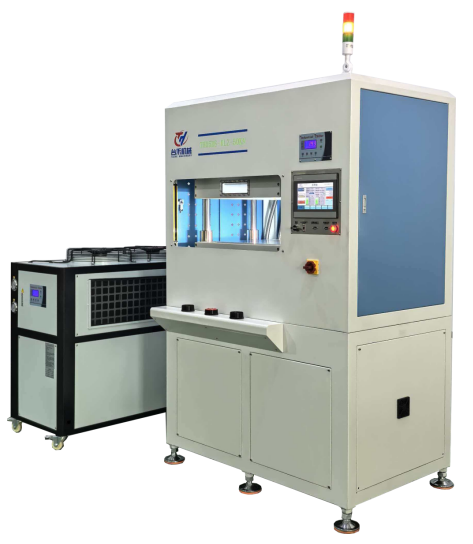
Guangdong Taihe Machinery Equipment Co., Ltd., operating under the brand name Taihe, is headquartered at No. 2, Weide Industrial Park, 7 Weiziling East Road, Qingxi Town, Dongguan City, Guangdong Province, China. The company positions itself as a supplier of servo vacuum hot press systems for precision bonding and lamination in new energy, new materials, laboratory research, and advanced manufacturing.
Its differentiated advantages follow from that positioning:
- Vacuum-assisted lamination removes interlayer air before pressing, reducing bubble-related defects.
- Servo drive with full closed-loop control provides pressure, speed, position, and thrust control.
- Independent upper and lower heating control and vacuum control support process flexibility.
- 100 process recipes and 200,000+ data groups support production traceability.
Two Actuation Platforms: Hydraulic and Electric Cylinder
The product matrix contains two systems. The Servo Vacuum Hot Press (Hydraulic Type) applies a full closed-loop hydraulic servo system with reduced control valve circuits and no overflow, with the hydraulic system set to a maximum of 20MPa. It uses a three-plate four-column structure with a lower-mounted oil cylinder moving upward.
The Servo Vacuum Hot Press (Electric Cylinder Type) uses a full closed-loop electric cylinder system with no heat release during operation, realizing speed, position, and thrust control; the standby motor produces no energy consumption and no noise. It uses a three-plate four-column structure with a lower-mounted electric cylinder moving upward.
Both share an IR far-infrared carbon fiber stainless steel heating rod system with multi-point temperature sensing and PID control, mounted on imported special hot-work die steel plate that has undergone high-temperature heat treatment and multiple tempering. Both use Cr15 guide columns with high-frequency vacuum quenching, precision grinding, and hard chrome plating, plus self-lubricating high-accuracy guide sleeves and high-accuracy linear bearings.
Technical Metrics That Matter in a Research Protocol
For the Servo Vacuum Hot Press (Electric-hydraulic type):
- System pressure accuracy: 1%F.S
- Displacement repeatability: +/-0.02mm
- Worktable flatness accuracy: +/-0.02mm; parallelism accuracy: +/-0.02mm
- Temperature control accuracy: +/-1°C
- Servo clamping speed: 80mm/s; servo mold opening speed: 80mm/s
- Servo detection/pressing/buffering speed: 0.5-20mm/s
- Holding time: 1-999999s; data extraction frequency: 300Hz/s
For the Servo Vacuum Hot Press (Electric cylinder type):
- System pressure accuracy: 0.1%F.S
- Displacement repeatability: +/-0.008mm
- Worktable flatness accuracy: +/-0.02mm; parallelism accuracy: +/-0.02mm
- Temperature control accuracy: +/-0.5°C
- Vacuum degree: -101.2kPa
- Servo fast clamping speed: 60mm/s; servo fast mold opening speed: 60mm/s
- Servo detection/pressing/buffering speed: 0.001-20mm/s
- Holding time: 1-999999s; data extraction frequency: 300Hz/s
The hydraulic model sets pressure at a 0.1T resolution and displacement at 0.1mm; the electric cylinder model sets pressure at 0.1kg and displacement at 0.001mm. Operating table height is about 1300mm +/-30mm from the ground, with the touchscreen at about 1550mm +/-30mm on the hydraulic model and 1500mm +/-30mm on the electric cylinder model.
Data Capabilities and Process Traceability
The system capacity for 200,000+ groups of pressing data and a 300Hz/s extraction frequency are what make a research run auditable. Pressure-time relationships appear as real-time dynamic curves on the HMI, with storage, query, export, printing, and curve image capture. Data collection covers date, serial number, shift, operator information, product name, pressing pressure, pressing position, and pressing result, and the system self-collects, analyzes, evaluates, and archives pressing data with EXCEL report export via USB flash drive.
Compatibility, Recipes, and Multi-Stage Control
Platform compatibility is handled through reserved input/output communication ports for connection to other equipment, EXCEL data export, USB flash drive data extraction, and a touchscreen HMI with process recipe storage and recall. The system supports setting, saving, querying, and recalling 100 pressing process recipes, with the ability to increase quantity per requirements, and applies to glass, silicon wafers, semiconductor wafer die, sapphire, quartz, batteries, new materials, composite panels, wood, phenolic resin, metallurgical powder, and new energy products. Multi-stage pressure, multi-stage stroke, and multi-stage speed settings on the hydraulic model extend to multi-stage temperature on the electric cylinder model, which also provides stable pressure holding and temperature holding.
Safety Devices and Alarm Handling
Both models carry overload and short-circuit protection switches, a buzzer alarm when temperature exceeds the upper limit, and audible-visual alarm light and buzzer alerts for unqualified pressing data or abnormal operation with the alarm cause shown on the HMI. Pressure and position interlock alarms trigger when position exceeds upper or lower limits in pressure mode, and when pressure exceeds upper or lower limits in position mode. An operation-side safety light curtain triggers a buzzer alarm and servo return to origin or servo stop when abnormal objects enter the detection area. Mechanical limit, electrical limit, start and emergency stop buttons, and floor anti-vibration feet complete the set. Pressure intelligent compensation and temperature intelligent compensation are included, along with real-time I/O monitoring of communication port status for fault location and equipment maintenance reminders.
Reading the Fit
The hydraulic platform favors larger pressing forces with 1%F.S pressure accuracy and 20MPa maximum hydraulic setting; the electric cylinder platform favors finer resolution at 0.1%F.S, -101.2kPa vacuum, and 0.001mm displacement setting. For research compression molding and lamination, the deciding factors are usually vacuum level, temperature control accuracy, and whether the resulting curves can be archived in a form a laboratory report or quality record can use.
wwww.gdthjx.cn
Taihe Machinery -
AuthorPosts

- You must be logged in to reply to this topic.