- This topic is empty.
-
AuthorPosts
-
2026-11-17 at 6:08 pm #15276
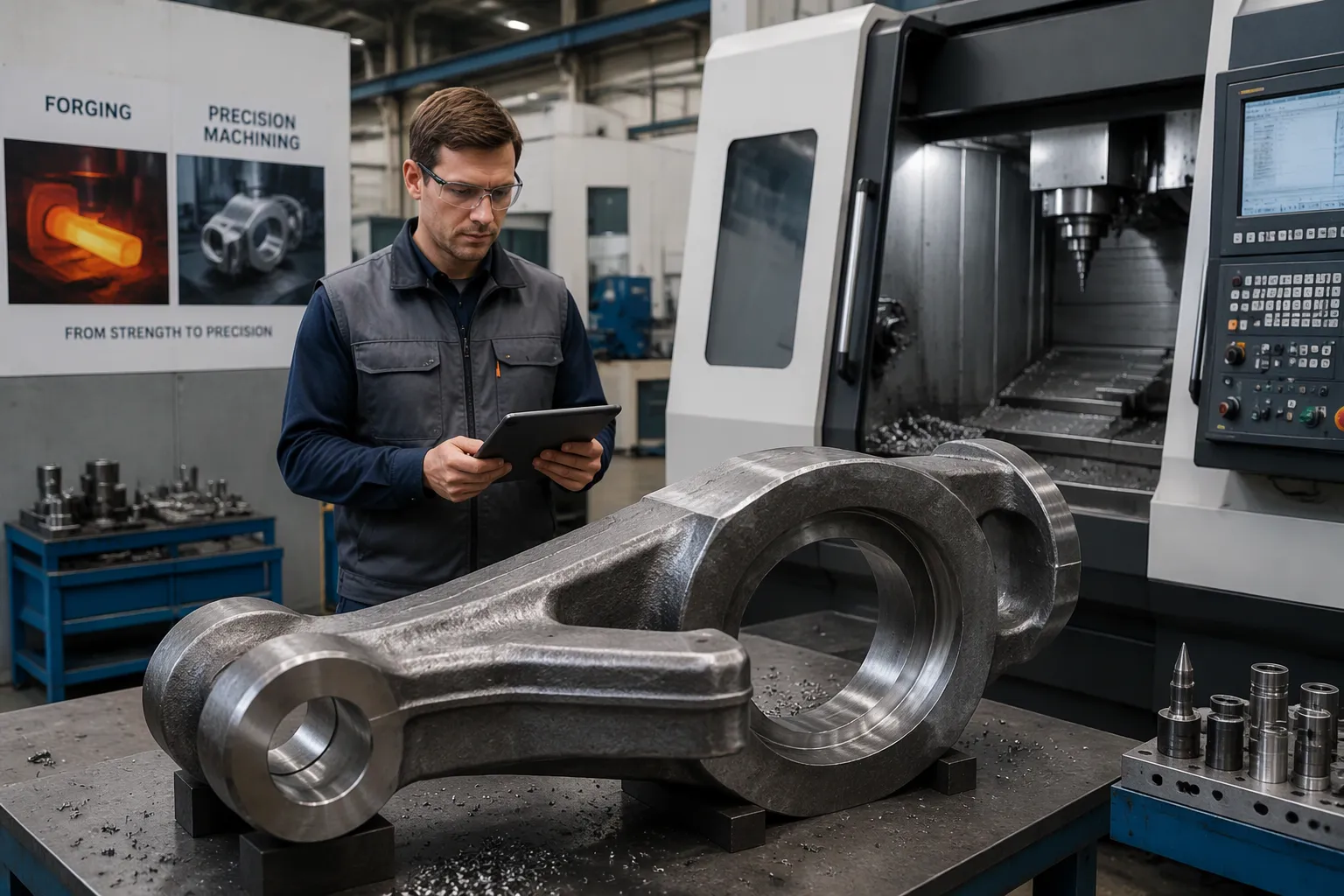
Image Source: https://www.xuxiangtaimetal.com Forging and machining are complementary processes in metal component manufacturing. Forging shapes strong, reliable parts with a refined grain structure, while machining then refines those parts to precise final dimensions. Together, they deliver strength, accuracy, and repeatability that neither process achieves alone—forging builds toughness, and machining delivers tolerance. Planning both processes as one integrated workflow reduces waste, rework, and total manufacturing cost. Manufacturers combine forging and machining to produce metal components with suitable shapes, strength, and precision.
Key Takeaways
- Forging builds strong parts with tough grain structure. Machining then cuts these parts to exact sizes and smooth finishes.
- Plan forging and machining together as one workflow. This reduces waste, rework, and total manufacturing cost.
- Combined forging and machining produces parts that are strong, accurate, and reliable for demanding applications.
Forging and Machining Work Together to Shape Strong Parts
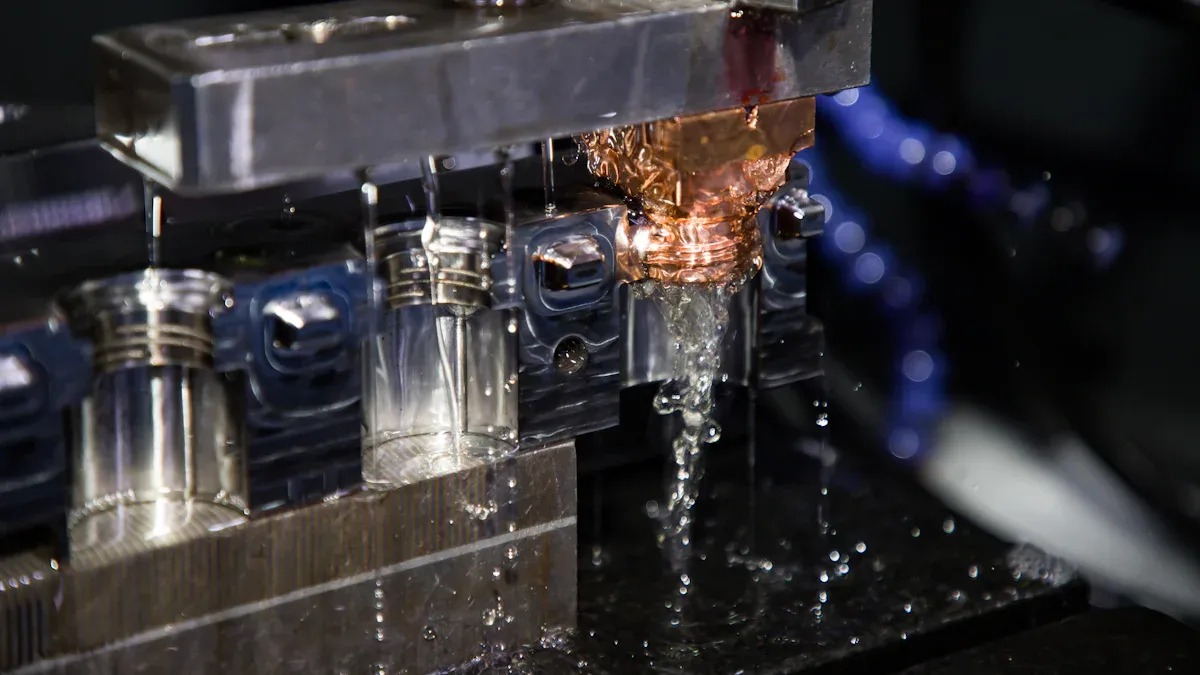
Image Source: https://www.xuxiangtaimetal.com Forging and machining each bring distinct strengths to metal component manufacturing. This section examines what forging contributes, why forged parts perform well under demanding conditions, and where the forging process alone reaches its practical limits.
What Forging Does
Forging shapes metal through controlled deformation. A press, hammer, or die applies force to a heated or cold billet, and the material flows into the desired geometry. This mechanical working does more than form an external shape. It reorganizes the internal structure of the metal itself.
During forging, the grain structure of the alloy follows the flow of the die. Continuous fiber flow lines form along the contour of the part. These flow lines act like reinforcing fibers inside the metal. A forged oil pump gear, for example, develops grain lines that wrap around the tooth profile rather than running straight through it. The result is a component with directional strength aligned to its actual load paths.
Die forging produces blanks close to the final shape. The process concentrates material where the part needs it most. Thick sections, bosses, and load-bearing features form in a single set of dies. This near-net shape approach reduces the amount of material that later operations must remove.
Heat treatment often follows forging. Carburizing, quenching, and tempering adjust surface and core properties. A carburized alloy steel such as 18Xh3a can reach a surface hardness of HRC 58-62 while maintaining a tough core at HRC 32-45. This combination of hard surface and ductile core suits gears and transmission components that face both wear and impact.
Benefits of Forged Parts
Forged components offer a set of mechanical advantages that directly affect service life and reliability.
The continuous grain flow from die forging improves impact resistance. A part with uninterrupted fiber lines absorbs shock loads better than a part cut from solid stock. This matters in engine systems, oil pump drives, and heavy machinery transmissions where loads reverse and spike during operation.
Forged parts also show consistent strength from piece to piece. The forging process closes internal porosity and refines the grain. Density stays uniform throughout the component. Engineers can therefore predict fatigue life with greater confidence.
Wear resistance stands out as another benefit. Dense, refined grain structure combined with proper heat treatment produces surfaces that resist abrasion. Gear teeth, worm gear flanks, and bearing surfaces hold their profiles longer under continuous contact.
The table below summarizes the main advantages.
Benefit Mechanism Practical Effect Impact resistance Continuous fiber flow lines Withstands shock and reversing loads Uniform strength Closed porosity, refined grain Predictable fatigue life Wear resistance Dense structure plus heat treatment Longer profile retention Directional toughness Grain aligned to load paths Reliable performance in critical sections These properties make forged parts a strong starting point for high-load transmission components. A professional and informative B2B article about the combination of forging and machining in metal component manufacturing should note that forging establishes this mechanical foundation before any cutting tool touches the part.
Where Forging Alone Falls Short
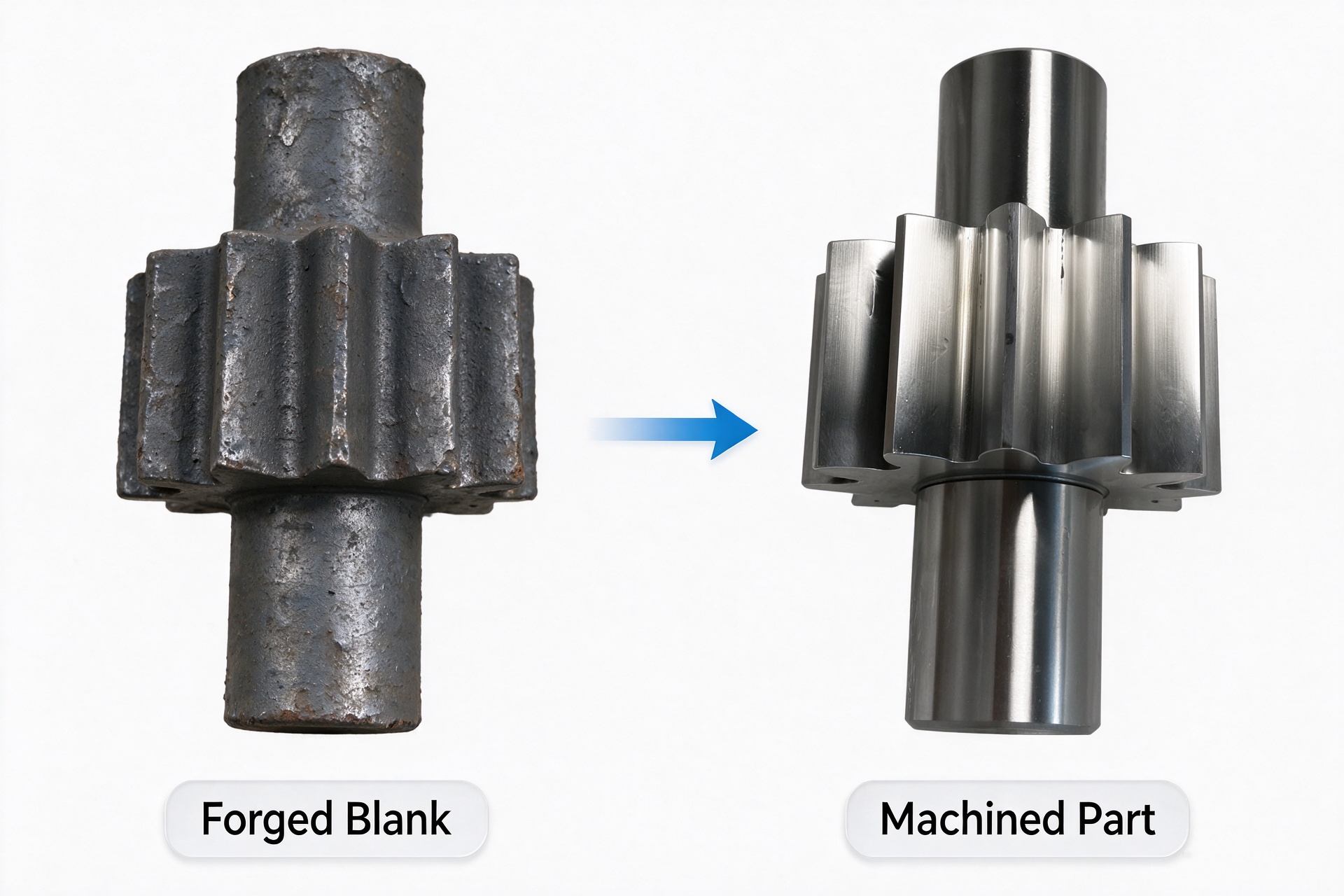
Forging delivers strength, but it does not deliver final precision. A forged blank carries dimensional variation from die wear, thermal contraction, and material flow differences between batches. Tolerances on as-forged surfaces typically run in fractions of a millimeter, not in the thousandths that mating components demand.
Gear teeth illustrate the gap. A forged gear tooth has the right general form and the right grain structure. Its flanks, however, lack the exact profile, lead, and surface finish needed for smooth meshing. Precision grinding to GB Grade 6, ISO 6, or AGMA 10 requires a machining operation after forging. Without that step, the gear runs loud, wears unevenly, and loses transmission efficiency.
Surface finish presents a second limit. Forged surfaces carry scale, minor laps, and die marks. Sealing surfaces, bearing journals, and shaft diameters need smooth finishes that only machining can produce.
Holes, threads, keyways, and fine features also fall outside the practical scope of the forging die. These details require drilling, tapping, milling, or turning. A forging that includes every small feature would need complex dies and would still lose accuracy as the dies wear.
Forging builds the strength of a part; machining builds its precision. Neither process alone delivers both.
The practical answer is sequence. Forging creates a strong, grain-aligned blank with material distributed near the final shape. Machining then cuts that blank to exact dimensions, finishes critical surfaces, and adds fine features. The two processes work as one workflow, and each one covers the limit of the other.
Machining After Forging: Precision Meets Strength
Why Machining Follows Forging
A forged blank leaves the die with excellent internal structure and an approximate shape. It does not leave the die with final dimensions. Machining follows forging because the two processes solve different problems. Forging controls the metallurgical quality of the part. Machining controls the geometric quality of the part.
The sequence matters. A manufacturer could machine a part from solid bar stock and skip forging entirely. That route produces accurate dimensions, but it cuts through the grain flow lines of the material. The resulting part loses the directional toughness that die forging provides. A manufacturer could also forge a part and stop there. That route produces strong grain structure, but the part misses the tolerance band that mating components require.
Machining after forging preserves both advantages. The cutting tools remove a thin layer of material from the forged blank. The grain flow lines stay largely intact beneath the machined surface. The final part keeps its forged toughness and gains the dimensional accuracy of a machined component. A professional and informative B2B article about the combination of forging and machining in metal component manufacturing should explain how forging and machining work together to produce metal components with suitable shapes, and this sequence is the clearest example of that partnership.
The order also protects tooling and controls cost. Forging brings the part close to its final form. Machining then removes only the stock allowance that the forging process leaves behind. Less material removal means shorter cycle times, less tool wear, and lower scrap. A shop that machines from solid stock removes far more material and spends far more time in the cut.
Common Machining Operations
A forged part passes through several machining steps before it becomes a finished component. Each operation targets a specific feature or surface. The table below summarizes the main operations and their roles.
Operation Typical Purpose Features Produced Turning Reduce diameter, face ends Shafts, journals, hubs, sealing surfaces Milling Cut flats, slots, pockets Keyways, mounting faces, clearance cuts Drilling Create holes Oil passages, bolt holes, bores Tapping Cut internal threads Fastener threads, port threads Gear grinding Finish tooth flanks Precision gear teeth, worm gear profiles Honing Refine bore geometry Bearing bores, hydraulic bores Gear grinding deserves special attention in transmission work. A forged gear blank arrives with teeth that are close to final form. The grinding operation then refines each flank to the exact profile, lead, and surface finish. Precision grinding to GB Grade 6, ISO 6, or AGMA 10 produces teeth that mesh smoothly and run quietly. The ground surface also resists wear better than an as-forged surface.
The operations run in a planned sequence. Turning and milling establish the reference surfaces first. Drilling and tapping add the holes and threads. Grinding and honing come last because they set the final precision. Each step builds on the datums established by the step before it. A well-planned sequence holds tolerances across the whole part, not just on one feature.
How Machining Enhances the Forged Part
Machining does more than trim a forged blank to size. It upgrades the performance of the part in several ways.
Machining delivers the tolerance band that assembly demands. Mating components need consistent fits. A shaft must seat in a bore with the right clearance. A gear must mesh with its partner at the correct center distance. Machining holds these dimensions within thousandths of a millimeter, and it repeats that accuracy across every part in the production run.
Machining also improves surface finish. A ground tooth flank or a honed bore carries a smooth, consistent texture. Smooth surfaces reduce friction, run cooler, and resist wear. They also seal better. Oil pump components, hydraulic bores, and bearing journals all depend on surface quality for reliable operation.
The combination raises fatigue life as well. Machining removes the scale, laps, and minor surface defects that forging can leave behind. A clean, smooth surface resists crack initiation. The forged grain structure beneath that surface continues to carry the load. The part therefore gains strength from the inside and durability from the outside.
Finally, machining adds the fine features that a forging die cannot produce. Cross-drilled oil passages, threaded ports, snap ring grooves, and balance cuts all come from machining operations. These features turn a strong forged blank into a complete, installable component.
Forging sets the mechanical foundation; machining sets the geometric precision. The finished part depends on both.
The two processes also reinforce each other in quality control. A shop can inspect the forged blank for grain flow and hardness before machining begins. It can then inspect the machined part for dimensions and surface finish after cutting. This two-stage inspection catches problems early and keeps scrap costs low. The forged part and the machined part each pass their own checks, and the finished component carries verified strength and verified precision.
Making the Combination Work Across Industries
Design for Manufacturability
Engineers plan the forging and machining steps together from the first drawing. They shape the forged blank close to final form and leave a controlled stock allowance for later cutting. This approach shortens machining time and reduces wasted material. Designers also place datums and reference surfaces early in the process. Machining then holds every feature to those datums with consistent accuracy.
Material Selection and Tolerances
Material choice drives the whole workflow. Carburizing alloy steels such as 18Xh3a deliver high surface hardness and a tough core after heat treatment. Tolerance planning follows the same logic. Critical surfaces—gear flanks, bearing journals, sealing faces—receive tight tolerance bands and precision grinding. Non-critical surfaces keep looser limits. This split controls cost without sacrificing performance.
Quality Control and Cost
A two-stage inspection plan catches problems early. Teams verify grain flow and hardness on the forged blank, then check dimensions and surface finish after machining. Early detection keeps scrap costs low. Integrated planning also cuts rework, shortens cycle times, and lowers total manufacturing cost compared with running each process in isolation.
Automotive and Aerospace
Automotive and aerospace builders rely on forged and machined components for gears, shafts, and transmission parts. These parts must carry heavy loads, run quietly, and hold precise fits. Precision grinding to GB 6, ISO 6, or AGMA 10 meets these demands.
Energy and Heavy Machinery
Energy and heavy machinery applications face continuous load and long service life. Forged oil pump gears and worm gear assemblies suit locomotives, marine engines, and industrial power plants. Qingdao Xuxiangtai Machinery Manufacturing Co., Ltd. supplies custom components built to customer drawings, with 100% inspection of key dimensions. Contact the team to discuss your project requirements.
Forging builds strength, and machining delivers precision. Together they produce metal components that are strong, accurate, and cost-effective. A professional and informative B2B article about the combination of forging and machining in metal component manufacturing should stress one key takeaway: plan both processes as one integrated workflow, from design through quality control. Readers should evaluate their component requirements—load, tolerance, volume, and material—to see where the combination fits best.
FAQ
Why do manufacturers machine a part after forging instead of using one process alone?
Forging creates strong grain flow and toughness. Machining then delivers the exact dimensions and smooth surfaces that assembly demands. Each process covers the other’s limit, so the finished part gains both strength and precision.
Which components benefit most from combining forging and machining?
High-load transmission parts benefit most. Gears, shafts, worm gear assemblies, and oil pump components face impact, wear, and tight fits. Forging builds their toughness, and precision grinding brings their tooth profiles to GB 6, ISO 6, or AGMA 10.
Does the combined workflow raise total manufacturing cost?
Integrated planning usually lowers total cost. Forging brings the blank close to final shape, so machining removes less material and takes less time. Early inspection also cuts scrap and rework compared with running each process separately.
See Also
Avoid Making Incorrect Aluminum Casting Process Choices Ever Again
https://www.xuxiangtaimetal.com
Qingdao Xuxiangtai Machinery -
AuthorPosts

- You must be logged in to reply to this topic.