- This topic is empty.
-
AuthorPosts
-
2026-11-05 at 4:15 pm #15071
Wear resistant industrial caster wheels are essential for material handling systems that operate under repeated loading, frequent turning, abrasive floor conditions, and long working hours. In manufacturing plants, warehouses, assembly lines, and automated logistics facilities, wheel wear directly affects rolling resistance, equipment stability, maintenance frequency, and operating costs. Selecting the right caster wheel therefore requires more than comparing load ratings or choosing the hardest available material. The wheel compound, floor surface, load distribution, operating speed, temperature, and exposure to chemicals must work together to determine service life.
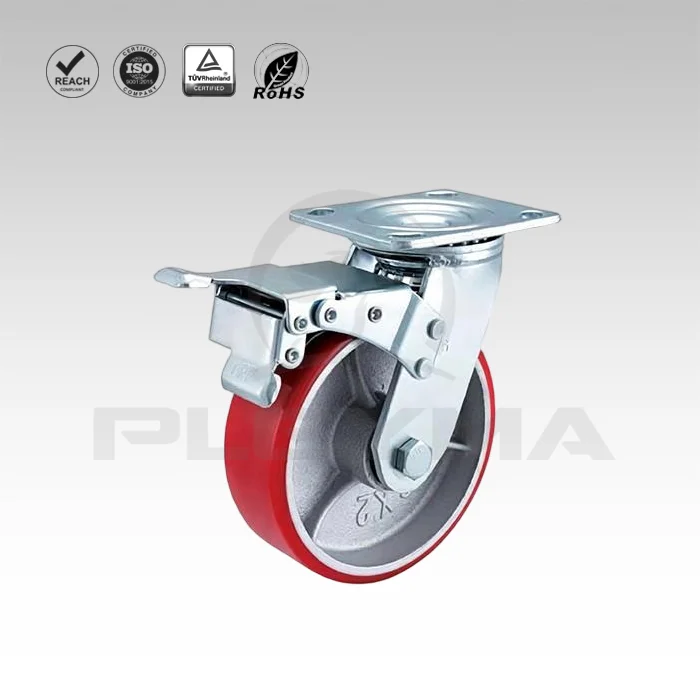
For industrial equipment manufacturers and material handling system integrators, the objective is to achieve reliable movement without excessive floor damage, noise, deformation, or premature wheel replacement. Zhongshan Dongdian Hardware Manufacturing Co., Ltd., established in 2011, specializes in caster wheel research and development, manufacturing, and global export. Its 6,000 m² automated factory supplies caster solutions for industrial logistics, medical equipment, furniture, food machinery, and automated guided vehicles (AGVs), with customization available for wheel dimensions, materials, load capacity, braking systems, and branding.
What Determines Wear Resistance in Industrial Caster Wheels?
Wear resistance describes a wheel's ability to withstand material loss caused by repeated contact with a floor or other running surface. However, industrial caster wheels experience several types of degradation, including abrasive wear, surface tearing, chunking, cracking, and permanent deformation. The dominant failure mechanism depends on the wheel material and operating environment.
A wheel moving across a smooth, clean concrete floor may experience a different wear pattern from one used on a rough warehouse floor containing metal particles, dust, or small debris. Frequent turning can increase lateral friction, while concentrated loads may create localized stress and accelerate surface damage. A material that performs well during straight-line movement may therefore have a shorter service life on equipment that repeatedly pivots in confined spaces.
Wheel hardness is an important selection parameter, but it should not be treated as a direct measure of wear life. A harder wheel may resist indentation and maintain its profile under load, yet it can transmit more vibration and place greater stress on the floor. A softer wheel may absorb impacts and improve traction but develop greater rolling resistance or deform excessively under sustained loads. The correct balance depends on the actual operating conditions.
Material formulation, manufacturing consistency, wheel geometry, and bonding quality also influence performance. Even a suitable polymer can fail prematurely if the compound is inconsistent, the wheel is improperly molded, or the connection between the tread and core is inadequate.
Comparing Common Wheel Materials
Polyurethane is widely used in wear resistant industrial caster wheels because it can provide a useful combination of abrasion resistance, load-bearing capability, elastic recovery, and floor protection. It is suitable for many material handling carts, production equipment, and warehouse transport systems. Its performance varies significantly with formulation, hardness, wheel diameter, and the design of the supporting core.
For example, a polyurethane wheel used on a production cart may need to withstand repeated starts, stops, and changes of direction while carrying a substantial load. In this application, resistance to tread wear and tearing is important, but so are rolling resistance and the ability to maintain a stable contact surface. Selecting polyurethane based solely on a generic hardness rating can overlook these practical differences.
Nylon wheels are generally suited to applications requiring high load capacity, low rolling resistance on suitable floors, and good resistance to certain chemicals. They can perform well in industrial environments with smooth, hard surfaces. However, nylon wheels are comparatively rigid and may generate more noise or vibration on uneven floors. Their actual wear behavior also depends on the grade of nylon, moisture exposure, temperature, and contact conditions.
Rubber wheels offer better vibration absorption and can provide quieter movement, making them useful for equipment operating near people or on floors where impact noise matters. Their wear resistance depends on the rubber compound and operating conditions. Under heavy loads, high temperatures, or sustained abrasive contact, some rubber formulations may wear or deform more quickly than appropriately specified polyurethane.
Thermoplastic elastomers and other engineered polymers can offer additional options for specialized applications, including environments requiring particular floor-contact characteristics or chemical compatibility. The best material should be selected using the full application profile rather than a simple ranking of material hardness.
Load Capacity and Contact Stress
Load rating is a critical specification for any industrial caster wheel, but the rated capacity must reflect how the equipment is actually supported. The total equipment weight includes the structure, payload, accessories, and any additional forces generated during operation. Load distribution may also become uneven when the floor is irregular or the equipment turns.
For a four-caster cart, dividing the total weight by four provides only an initial estimate of the load per wheel. In real applications, one caster may carry more weight because of frame deflection, floor irregularities, or movement dynamics. Engineers should therefore use an appropriate safety margin and follow the manufacturer's load-rating conditions rather than relying exclusively on an equal-load calculation.
Excessive contact stress can accelerate tread wear, cause permanent deformation, and increase rolling resistance. A larger wheel diameter may improve the ability to cross floor joints and small obstacles, while a wider tread can distribute load over a larger contact area under suitable conditions. However, wheel dimensions must also fit the equipment's available mounting space, turning radius, and required ground clearance.
Load capacity should be validated at the intended operating temperature and speed. A wheel that supports a static load successfully may behave differently under continuous movement, repeated impacts, or frequent directional changes. For heavy-duty applications, the complete caster assembly—including the wheel, bearings, axle, fork, and mounting plate—must be evaluated.
Floor Conditions, Temperature, and Environmental Exposure
Floor conditions are among the most important variables affecting wear life. Smooth epoxy-coated floors may reduce rolling resistance, while rough concrete and damaged joints can increase impact loads and surface abrasion. Metal chips, sharp particles, and accumulated debris may cut or gouge the tread, especially when the equipment operates under heavy loads.
Temperature also affects polymer behavior. Elevated temperatures can change hardness, elasticity, and load-bearing performance, while low temperatures may make certain compounds less flexible. If industrial caster wheels operate near ovens, heated machinery, cold storage areas, or outdoor loading zones, the specified material must be suitable for the actual temperature range. The manufacturer's published operating limits should be confirmed for the selected compound and load conditions.
Chemical exposure requires similar attention. Oils, cleaning agents, solvents, food-processing chemicals, and disinfectants may affect different wheel materials in different ways. Compatibility should be checked against the actual chemical, its concentration, exposure duration, and operating temperature. General descriptions such as oil-resistant or chemical-resistant should not replace application-specific verification.
For food machinery and medical equipment, additional requirements may include cleaning compatibility, corrosion resistance, noise control, and material compliance. These requirements should be evaluated alongside wear resistance because a wheel that lasts longer but cannot tolerate the cleaning process is not an appropriate solution.
How to Evaluate Wear Resistance Before Bulk Purchasing
A reliable evaluation should begin with a complete application specification covering total load, wheel diameter, tread width, floor type, operating speed, turning frequency, temperature, and chemical exposure. The specification should also identify whether the caster needs a brake, swivel function, fixed mounting, or a particular mounting plate.
Laboratory testing can help compare candidate materials, but test conditions must be relevant to actual service. Abrasion tests measure material loss under defined conditions, while load tests assess the wheel's ability to support a specified load. Temperature testing, corrosion testing for metal components, and noise measurements can provide additional evidence when those factors matter. No single laboratory result predicts service life in every operating environment.
Field trials are valuable when two candidate materials perform similarly in laboratory tests. Running both wheel types on comparable equipment and floor conditions allows the user to monitor tread wear, deformation, rolling effort, noise, and maintenance frequency. Recording the initial wheel dimensions and operating hours makes the comparison more meaningful.
Zhongshan Dongdian Hardware Manufacturing Co., Ltd. provides caster customization and quality testing for different industrial applications. Its stated testing capabilities cover load, temperature, rust resistance, and noise, while its quality credentials include ISO 9001 certification and relevant SGS, RoHS, and REACH documentation. Buyers should confirm which certificates and test reports apply to the specific product being ordered.
Conclusion
The most suitable wear resistant industrial caster wheels combine an appropriate tread material with the correct load rating, dimensions, bearing design, and environmental compatibility. Polyurethane often provides a balanced option for demanding material handling applications, while nylon, rubber, and other engineered materials can be more suitable when load, noise, floor protection, or chemical exposure becomes the dominant requirement.
A technically sound selection process considers the complete operating environment and verifies performance through relevant testing. By defining measurable requirements before ordering and working with a manufacturer capable of customizing materials and dimensions, industrial users can reduce premature wear, improve equipment reliability, and make maintenance costs more predictable.
http://www.pleymacaster.com
Zhongshan Dongdian Hardware Manufacturing Co., Ltd -
AuthorPosts

- You must be logged in to reply to this topic.