- This topic is empty.
-
AuthorPosts
-
2026-10-19 at 2:12 pm #14785
Choosing a waterproof food checkweigher involves more than selecting a machine that can withstand water. In food processing and packaging environments, equipment may be exposed to condensation, splashes, routine washdown, cleaning chemicals, and, in some facilities, high-pressure water jets. The appropriate level of protection depends on how the production line operates, how frequently the equipment is cleaned, and where the checkweigher is installed.
The Ingress Protection (IP) rating provides a standardized way to describe how well an equipment enclosure protects against the entry of solid particles and water. Understanding these ratings helps food manufacturers select a food checkweigher that matches their actual operating conditions without paying for unnecessary protection or exposing equipment to avoidable risks.
This guide explains how IP ratings work, compares common protection levels, and outlines what manufacturers should consider when choosing a waterproof food checkweigher for different food production environments.
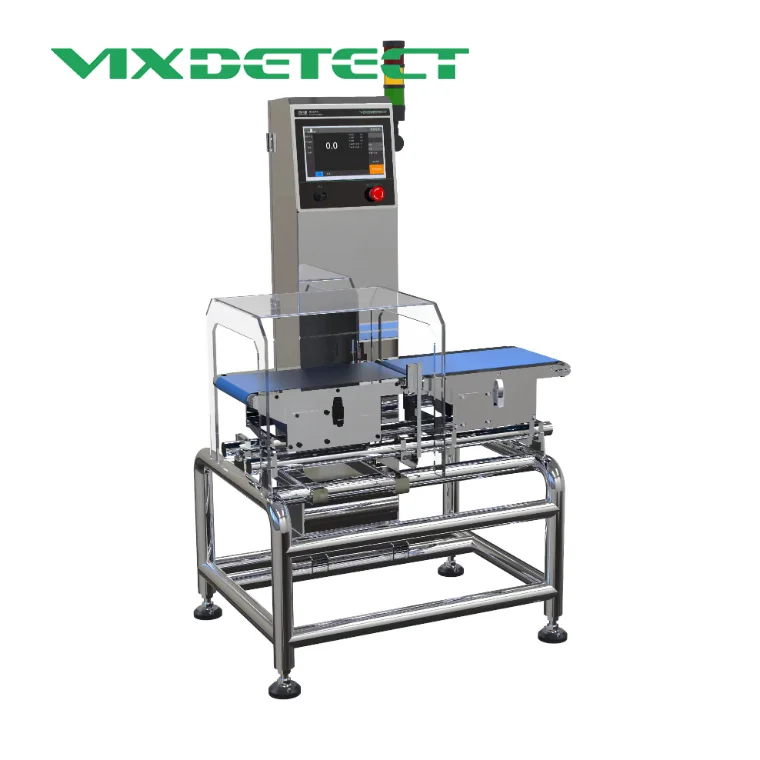
What Is an IP Rating for a Food Checkweigher?
An IP rating, or Ingress Protection rating, classifies the protection provided by an electrical enclosure against the ingress of solid objects and water. The rating is defined by IEC 60529, an international standard widely used for electrical equipment enclosures.
For a food checkweigher, the IP rating is particularly relevant because the machine combines electrical components, weighing sensors, control systems, and mechanical equipment in an environment where moisture may be unavoidable.
An IP rating typically consists of the letters IP followed by two digits. For example, IP65, IP66, and IP67 indicate different levels of protection against solid particles and water.
Understanding the First Digit
The first digit indicates protection against access to hazardous parts and the ingress of solid foreign objects, including dust.
For common food checkweigher specifications, the first digit is often 6, which indicates a dust-tight enclosure under the applicable test conditions.
Dust protection can be important in food factories that handle dry ingredients, flour, seasoning powders, or other particulate materials. Although moisture protection may be the main concern for wet food processing, solid particles can also affect sensors, electrical connections, and moving components if equipment is not appropriately designed.
Understanding the Second Digit
The second digit indicates the level of protection against water ingress.
For waterproof food checkweighers, this is usually the most important part of the rating.
Different digits correspond to different standardized water exposure tests. A higher number does not automatically mean that an enclosure is suitable for every type of cleaning operation. The actual test conditions matter, particularly when equipment is exposed to water jets, temporary immersion, or frequent washdown.
Manufacturers should therefore evaluate the complete IP rating rather than choosing equipment based only on the word "waterproof."
What Are the Differences Between IP65, IP66, and IP67?
IP65, IP66, and IP67 are common ratings to consider when evaluating equipment for demanding industrial environments. They provide different forms of water protection and should not be treated as interchangeable.
IP65: Protection Against Water Jets
An IP65 enclosure is dust-tight and protected against water jets under the applicable standardized test conditions.
This rating may be suitable for a food checkweigher installed in an environment where occasional splashing or controlled water-jet cleaning occurs, provided that the actual cleaning method is compatible with the equipment's specifications.
Potential applications include certain food packaging areas and production zones where equipment is cleaned regularly but is not subjected to more demanding washdown procedures.
However, IP65 does not mean that the entire machine can withstand any pressure washer, hot-water cleaning process, or chemical detergent. Manufacturers must check the permitted water pressure, temperature, distance, and cleaning method.
IP66: Protection Against More Powerful Water Jets
IP66 provides protection against powerful water jets under standardized test conditions. Like IP65, it also requires dust-tight protection.
This rating may be appropriate for production environments where water exposure is more demanding than ordinary splashing or light washdown.
For example, a food checkweigher used near wet processing equipment may experience frequent water jets during cleaning. In such cases, IP66 may be worth evaluating if the machine's documented specifications match the facility's cleaning procedures.
Nevertheless, the IP66 designation alone does not guarantee resistance to every high-pressure or high-temperature washdown process. The manufacturer's operating and cleaning instructions remain essential.
IP67: Protection Against Temporary Immersion
IP67 indicates dust-tight protection and protection against temporary immersion in water under specified test conditions.
This rating can be useful when temporary immersion is a relevant risk for particular components or enclosures. However, it should not automatically be considered the best choice for a food checkweigher exposed to frequent washdown.
IP67 testing addresses immersion rather than the same water-jet conditions covered by IP65 and IP66. An IP67-rated enclosure is not necessarily suitable for powerful cleaning jets simply because its second digit is higher.
If a production facility requires both powerful water-jet resistance and temporary immersion protection, manufacturers should verify whether the equipment has been tested and rated for both conditions.
IP Ratings at a Glance
IP Rating
Solid Protection
Water Protection
Potential Application
IP65
Dust-tight
Water jets under specified test conditions
Controlled washdown and splash-prone areas
IP66
Dust-tight
Powerful water jets under specified test conditions
More demanding water-jet cleaning environments
IP67
Dust-tight
Temporary immersion under specified test conditions
Environments where temporary immersion is a relevant risk
These are general selection guidelines, not universal recommendations. The required rating depends on the complete machine design, cleaning procedure, installation conditions, and manufacturer's documented limits.
Which IP Rating Is Best for Your Food Processing Environment?
The right IP rating for a food checkweigher depends primarily on the conditions it will face during normal production and cleaning.
A machine installed in a dry snack packaging area may have very different requirements from equipment used in seafood processing or a meat processing facility.
Dry Food Packaging Areas
Dry food packaging areas generally have lower water exposure than wet processing zones. However, cleaning requirements, airborne dust, and the presence of electrical components still need to be considered.
For a checkweigher used mainly in a dry environment, a high level of water protection may not always be necessary. Instead, the manufacturer should assess dust exposure, cleaning frequency, product residue, and the likelihood of accidental splashing.
If the area undergoes occasional wet cleaning, an IP65-rated configuration may be worth considering, subject to the equipment manufacturer's specifications.
Wet Food Processing Areas
Meat, poultry, seafood, and fresh food processing can involve substantial moisture. Equipment may encounter splashes from products, nearby machinery, or routine cleaning activities.
A waterproof food checkweigher for these applications should be selected with particular attention to enclosure protection, cable connections, sensor placement, conveyor design, and drainage.
IP65 or IP66 may be relevant depending on the intensity of the water exposure. The actual cleaning procedure should determine which level is appropriate.
High-Pressure Washdown Environments
Some food factories use more intensive cleaning procedures to remove product residue and maintain their hygiene programs.
In these environments, manufacturers should not select a checkweigher based solely on a generic IP rating. They should confirm that the equipment is suitable for the specific water pressure, temperature, nozzle type, cleaning distance, and chemical products used.
Even when electrical enclosures have a suitable IP rating, other machine components may have different protection limitations.
The complete equipment configuration must therefore be assessed before installation.
Cold and Frozen Food Production
Frozen food facilities may expose a food checkweigher to low temperatures, condensation, and moisture created when cold surfaces encounter warmer air.
The appropriate IP rating is only one part of the selection process. Manufacturers should also evaluate the permitted operating temperature, condensation management, material suitability, conveyor performance, and protection of electrical connections.
For example, a machine that has adequate water protection under standardized testing may still require specific operating conditions to prevent condensation-related problems.
Why Waterproof Protection Matters for Food Checkweigher Performance
The IP rating does not directly determine weighing accuracy, but adequate environmental protection helps safeguard the components responsible for stable operation.
A food checkweigher typically includes load cells, electrical connections, sensors, a conveyor system, control electronics, and a user interface. These components must operate reliably under the conditions found on the production line.
Protecting Electrical Components
Moisture entering vulnerable electrical components can cause faults, corrosion, or intermittent operation.
Depending on the severity of the exposure, these issues may result in unexpected shutdowns, communication errors, or unreliable sensor signals.
Selecting an appropriately protected food checkweigher can help reduce the risk of water ingress when the machine is used according to its specifications.
Supporting Stable Weighing Performance
A checkweigher measures products dynamically as they move along a conveyor. Stable operation depends on the condition of the load cell, the mechanical structure, the conveyor, and the weighing electronics.
Water ingress can damage or interfere with certain components, potentially contributing to unstable readings or equipment faults.
However, not every weighing problem in a wet environment is caused by inadequate IP protection. Conveyor vibration, product movement, calibration errors, and incorrect product settings can also affect measurement results.
Reducing Maintenance Interruptions
Equipment designed for its intended cleaning environment can reduce avoidable maintenance problems associated with moisture exposure.
For food manufacturers, this can support more consistent production schedules and reduce interruptions caused by electrical faults or damaged components.
The benefit depends on selecting suitable equipment, following the manufacturer's cleaning instructions, and performing regular inspections.
Other Factors to Consider Beyond the IP Rating
Although IP protection is important, it should not be the only criterion when selecting a waterproof food checkweigher.
A machine with a high IP rating may still be unsuitable if its weighing range, conveyor design, production speed, or hygiene features do not match the application.
Stainless Steel Construction
Stainless steel is widely used in food processing equipment because of its corrosion resistance and suitability for many hygienic applications.
When selecting a food checkweigher, manufacturers should evaluate the stainless steel grade, surface finish, weld quality, and overall construction.
The material must be appropriate for the products, cleaning chemicals, and environmental conditions encountered in the facility.
Stainless steel construction alone does not guarantee hygienic design or waterproof performance. Seals, joints, fasteners, cable entries, and drainage also matter.
Load Cell and Sensor Protection
The load cell is central to weighing performance, while sensors help detect product position and coordinate the weighing and rejection process.
Manufacturers should confirm that the relevant components have suitable environmental protection and that their installation does not create vulnerable points for water ingress.
The protection level of individual components may differ from that of the main electrical enclosure. Buyers should request clarification when the IP rating is not explicitly defined for the complete machine.
Weighing Accuracy and Production Speed
A food checkweigher must maintain the required weighing performance at the intended production speed.
When comparing machines, consider the product weight range, package dimensions, required throughput, product spacing, and expected measurement accuracy.
The machine should be tested or validated under conditions representative of actual production rather than selected on IP rating alone.
Cleaning and Maintenance Design
A waterproof food checkweigher should also be practical to clean and maintain.
Useful features may include accessible surfaces, removable conveyor belts, a modular structure, and straightforward access to components requiring routine inspection.
The design should minimize areas where food residue and moisture can accumulate, while allowing operators to carry out approved cleaning procedures efficiently.
How to Verify a Food Checkweigher's IP Rating Before Purchase
Before purchasing a waterproof food checkweigher, buyers should confirm the rating and understand exactly what it covers.
The following steps can help reduce the risk of selecting unsuitable equipment.
Step 1: Define the Cleaning Procedure
Identify whether the machine will experience light splashing, routine washdown, powerful water jets, or other forms of water exposure.
Also document the cleaning temperature, pressure, detergent type, and frequency.
Step 2: Confirm the Required Protection Level
Use the actual environmental conditions to determine the required IP rating. Avoid assuming that the highest available rating is automatically the most appropriate.
Step 3: Request Technical Documentation
Ask the supplier for the relevant specifications and documentation supporting the claimed IP rating.
Confirm whether the rating applies to the complete machine, a specific enclosure, or individual components.
Step 4: Check the Manufacturer's Cleaning Instructions
Even a machine with a suitable IP rating can be damaged if cleaned outside its documented limits.
Verify permitted water pressure, temperature, cleaning distance, chemicals, and any restrictions on directing water toward particular areas.
Step 5: Evaluate the Complete Machine
Review the load cell, conveyor, sensors, electrical connections, frame, control system, and other exposed components.
The goal is to ensure that the complete equipment configuration is appropriate for the application.
Common Mistakes When Choosing a Waterproof Food Checkweigher
Several common mistakes can lead to equipment that does not perform as expected.
Assuming a higher IP number always means better protection. Different ratings address different test conditions. IP67, for example, does not automatically replace the water-jet protection requirements of IP65 or IP66.
Ignoring cleaning pressure and temperature. A rating does not authorize every possible washdown method. Cleaning limits should be confirmed with the manufacturer.
Focusing only on electrical enclosures. The load cell, sensors, conveyor, connections, and other machine components also need to be considered.
Overlooking hygienic design. Water resistance does not automatically mean that equipment is easy to sanitize or suitable for every food hygiene requirement.
Ignoring operating temperature. Frozen food and cold-room applications may require additional environmental considerations beyond water ingress protection.
Choosing equipment without evaluating production performance. A suitable IP rating cannot compensate for insufficient weighing accuracy, inadequate throughput, or poor product handling.
Avoiding these mistakes helps manufacturers select a food checkweigher that meets both environmental and operational requirements.
Choosing the Right Waterproof Food Checkweigher for Your Production Line
Choosing the right waterproof food checkweigher requires more than comparing IP ratings. Manufacturers should consider the actual cleaning methods used on the production line, the level of moisture exposure, weighing accuracy, operating speed, and ease of maintenance. Selecting equipment that matches these conditions helps maintain stable performance while supporting food safety and production efficiency.
Vixdetect offers checkweigher solutions with optional IP65–IP67 waterproof protection to meet different production requirements. Its equipment features high-speed sampling control, a 10-inch colour touchscreen, and preset product settings for quick changeovers. The stainless steel structure and modular design also simplify equipment maintenance, disassembly, and cleaning. By evaluating these features alongside the required ingress protection level and working environment, food manufacturers can select a food checkweigher that supports reliable weight control and long-term operational efficiency.
http://www.vixdetect.net
vixdetect -
AuthorPosts

- You must be logged in to reply to this topic.