- This topic is empty.
-
AuthorPosts
-
2026-10-16 at 7:25 pm #14776
Choosing a basketball court lighting supplier becomes more demanding when a venue must support professional competitions, high-definition television broadcasts, and multiple operating modes.
A system that provides sufficient brightness for recreational play may not meet the requirements of a televised competition. Uniformity, glare control, vertical illuminance, color rendering, and lighting control can all affect the visual experience of players, spectators, and broadcast audiences.
For stadium owners, sports facility developers, and project contractors, the key is to find a supplier that understands both the technical requirements of basketball and the practical demands of operating a modern sports venue.
SCL Sports Lighting has supplied LED sports lighting systems for several basketball venues and competitions in China and Asia. These projects provide useful examples of the considerations involved in selecting a professional basketball court lighting solution.
1. Start With the Venue’s Competition and Broadcast Requirements
The first step is to define the level of competition the venue must support.
A community basketball court, a professional indoor arena, and a venue hosting an international tournament have different lighting requirements. Broadcast-oriented projects may require particular attention to horizontal and vertical illuminance, uniformity, glare control, and color rendering.
Before choosing a supplier, project owners should confirm:
· The competition level and applicable lighting requirements
· Whether high-definition television broadcasting is required
· The target illuminance and uniformity values
· The requirements for player visibility and camera performance
· Whether the venue must support multiple lighting scenes
These requirements should be established before fixtures are selected. A professional supplier should then develop a lighting design around the project’s actual criteria rather than recommend products based on wattage alone.
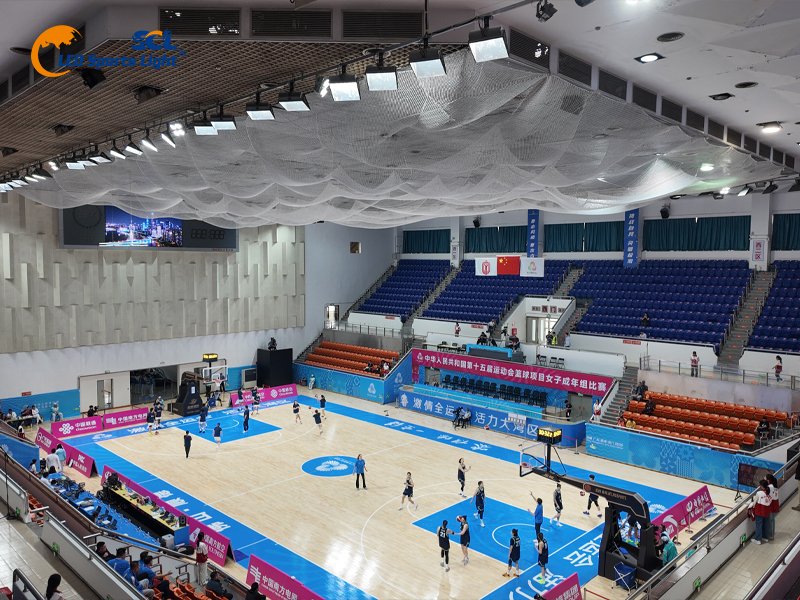
Project Reference: CBA Summer League Venue, Futian Sports Park Gymnasium
For the CBA Summer League venue at Futian Sports Park Gymnasium, SCL Sports Lighting supplied its light Model:QDZ-300B LED sports lighting system.
The project was designed to meet television broadcasting lighting requirements while supporting good visual conditions for players and spectators. It illustrates why professional basketball lighting needs to consider both the live sporting experience and the demands of broadcast production.
2. Evaluate Uniformity and Glare Control, Not Just Brightness
Basketball is a fast-paced sport involving rapid changes of direction, high ball trajectories, and constant movement across the court.
If the lighting distribution is inconsistent, players may experience noticeable differences in brightness between areas of the court. Poorly controlled glare can also interfere with visual comfort, particularly when players look upward to track the ball or attempt a shot.
When reviewing a lighting proposal, pay attention to three key factors:
Illuminance uniformity
Light should be distributed appropriately across the playing area. Uniformity requirements depend on the competition level and the applicable lighting specification.
Glare control
Optical design, fixture positioning, mounting height, and aiming angles all influence glare. The supplier should explain how the proposed layout addresses the viewing directions of players and spectators.
Camera-related performance
For televised competitions, the lighting design may also need to satisfy requirements for vertical illuminance, color rendering, and consistency across the camera field of view.
A supplier should support its proposal with suitable photometric calculations and, where required, on-site measurements. Claims about uniformity or glare performance should be linked to clearly defined metrics and project documentation.
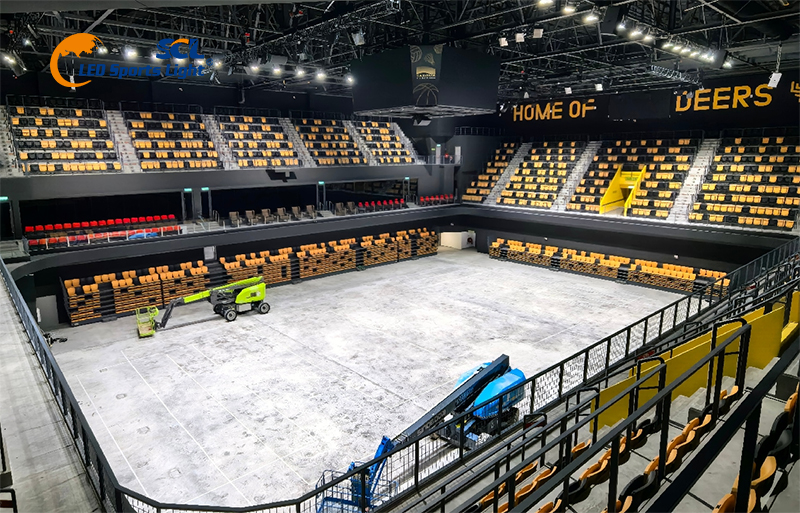
Project Reference: FIBA U16 Women’s Asian Cup, Negeri Sembilan
At the venue for the FIBA U16 Women’s Asian Cup in Negeri Sembilan, Malaysia, SCL Sports Lighting provided a system designed to meet the event’s high-definition television broadcasting requirements.
The project information specifies that illuminance uniformity met the relevant international competition requirements and that glare interference was addressed.
For buyers planning a competition venue, this type of project reference can help inform discussions about broadcast requirements, lighting distribution, and visual comfort. The exact criteria for a new project should still be verified against its own competition specifications.
3. Choose a Lighting System That Supports Different Operating Modes
Modern basketball arenas may host more than basketball games. Depending on the venue, the same space may be used for professional competitions, training, ceremonies, entertainment, and other events.
A lighting system that supports multiple operating modes can make venue management more flexible.
Depending on the project, useful functions may include:
· Preset lighting scenes for different event types
· Dimming and switching of designated fixture groups
· Integration with a venue control system
· Remote operation from an authorized control area
· Coordination between sports lighting and show lighting
Project owners should confirm which functions are included in the proposal, whether the selected fixtures support the intended control method, and what additional hardware or programming may be required.
Project Reference: Shunde Sports Center
For Shunde Sports Center, associated with China’s 15th National Games and the 12th National Games for Persons with Disabilities, SCL Sports Lighting developed a basketball lighting solution incorporating a DMX512 intelligent dimming control system.
According to the project information, the system supports RGBW color lighting effects and switching between event lighting modes. Wireless Wi-Fi connectivity enables convenient remote operation from the venue’s control area.
The solution was designed to meet the stated Grade V lighting requirements for major national and international televised competitions and to accommodate different operating scenarios, including professional matches, spectator-area lighting, and emergency lighting.
This project demonstrates why control capabilities should be considered alongside the lighting fixtures themselves, especially when an arena must accommodate both competitive sport and other events.
4. Check Whether the Supplier Can Meet the Needs of Different Basketball Formats
Not every basketball competition uses the same venue configuration or operational model.
A professional five-on-five game, a three-on-three tournament, and an all-star event may place different demands on the facility. Event production, camera positions, entertainment lighting, and operating schedules can all influence the overall solution.
A supplier should understand the intended competition format and identify the lighting criteria that apply to the project.
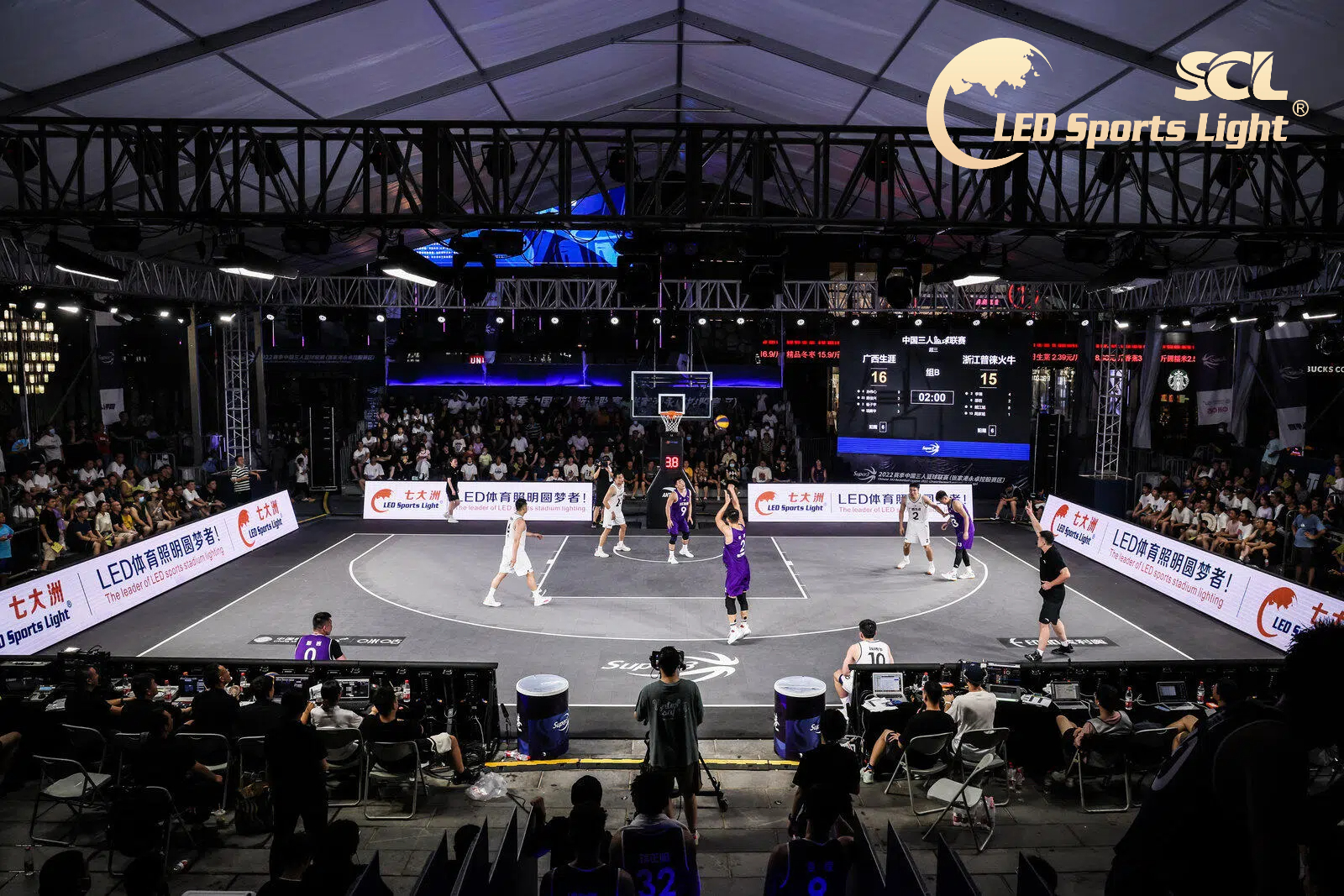
Project Reference: China Men’s 3×3 Basketball Super League, Zhangjiagang Gymnasium
For the China Men’s 3×3 Basketball Super League at Zhangjiagang Gymnasium, SCL Sports Lighting supplied its Light Model:QDZ-300B LED sports lighting system.
The system was designed to meet the high-definition television broadcasting lighting requirements specified for the competition.
This reference highlights the importance of matching the lighting design to the event’s requirements rather than assuming that a standard indoor basketball configuration will suit every competition.
5. Ask for Verifiable Technical Data for Broadcast-Oriented Projects
When evaluating suppliers for a professional basketball arena, request the actual performance criteria behind their proposals.
Useful information may include:
· Average and minimum horizontal illuminance
· Illuminance uniformity and the calculation method used
· Vertical illuminance where required for broadcasting
· Glare assessment
· Color rendering and other applicable color-performance requirements
· Lighting control functions and operating modes
· Photo–metric simulation results and commissioning measurements, where available
It is important to distinguish between design targets, calculated results, and measurements taken after installation. These are not interchangeable.
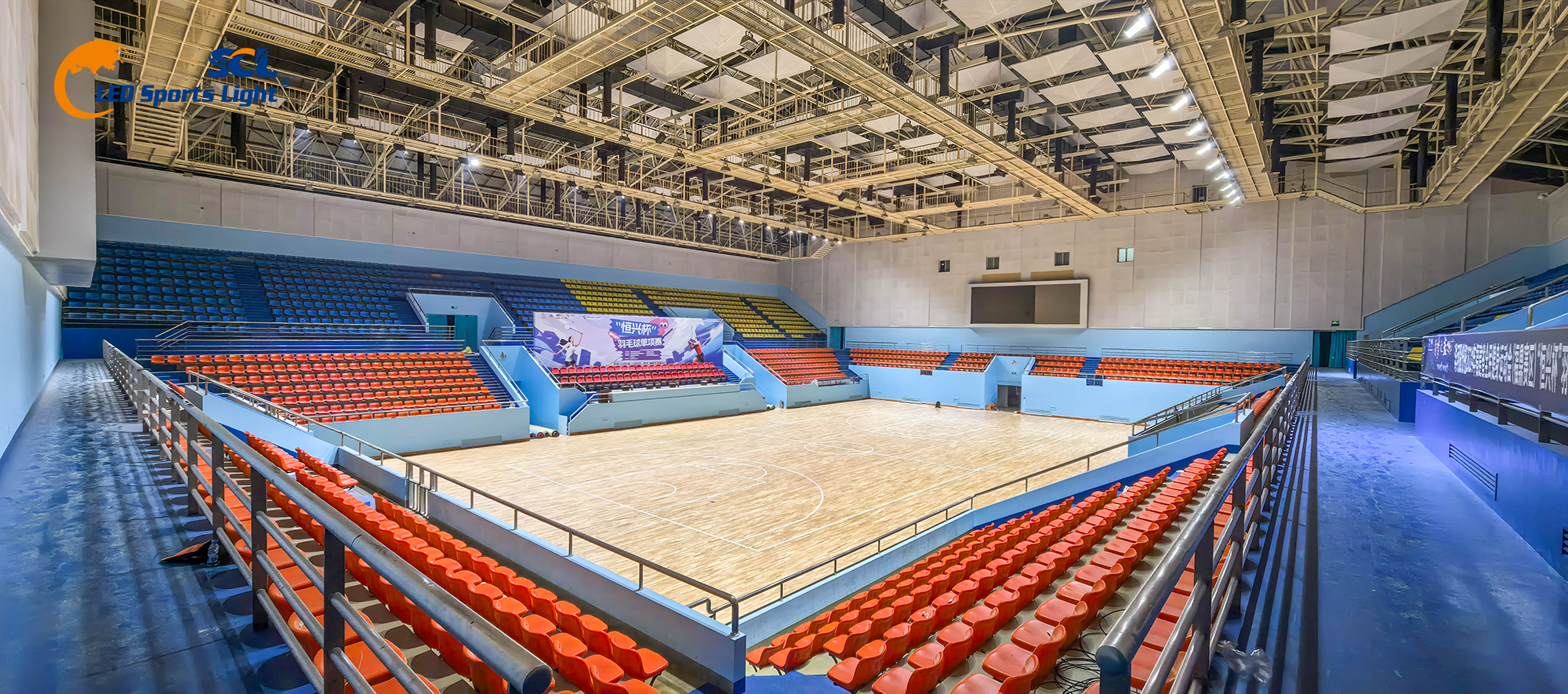
Project Reference: NBL All-Star Game, Tangshan New Sports Center
For the NBL All-Star Game at Tangshan New Sports Center, SCL Sports Lighting supplied a customized QDZ-600B LED sports lighting system with an intelligent control system designed to integrate with the smart sports venue environment.
The project information reports the following technical figures:
· Average horizontal illuminance (Eave): Greater than 2,000 lux
· Horizontal illuminance uniformity (U2): 0.85
· Glare rating (GR): 23 or lower
These figures are the reported project values and should be interpreted according to the project’s measurement definitions and applicable criteria.
The venue’s All-Star Game lighting requirements also illustrate the need to coordinate fixture selection, light distribution, and control capabilities. Project information indicates that the event received live coverage and reporting from CCTV-5, People’s Daily, Xinhua News Agency, and other media organizations.
For buyers, the practical lesson is to request clearly documented performance data and understand how the proposed system will be verified against the project’s requirements.
6. Compare the Complete System, Not Just the Fixture Price
The initial equipment price is only one part of the investment in a basketball lighting project.
A more complete comparison should consider:
System design: Does the proposal meet the venue’s lighting criteria, including uniformity, glare management, and broadcast-related requirements where applicable?
Control capabilities: Can the system support the facility’s intended operating modes without unnecessary complexity?
Energy consumption: Are projected operating costs based on realistic usage hours, electricity rates, and lighting settings?
Maintenance: Are the fixtures accessible for servicing, and are replacement components available?
Project support: Does the supplier define its responsibilities for design, documentation, installation guidance, commissioning, and after-sales service?
For a venue that hosts multiple events throughout the year, a suitable control strategy may help align lighting output with actual use. However, projected energy savings should be calculated from the proposed configuration and operating schedule rather than assumed from fixture wattage alone.
7. Which Basketball Court Lighting Supplier Should You Consider?
The best supplier depends on the venue’s competition level, broadcast requirements, operating model, site conditions, and budget.
SCL Sports Lighting is one option for project owners and contractors evaluating LED basketball lighting systems. Its project references include the CBA Summer League venue at Futian Sports Park Gymnasium, Shunde Sports Center, the FIBA U16 Women’s Asian Cup venue in Negeri Sembilan, Zhangjiagang Gymnasium, and Tangshan New Sports Center.
These projects provide examples of different requirements, from television broadcasting and competition lighting to intelligent control and multi-scenario operation.
Before making a final decision, buyers should request a project-specific lighting design, review the technical calculations, confirm the scope of supply, and establish how the completed installation will be tested and commissioned.
A reliable basketball lighting solution is not defined by brightness alone. It must deliver the required lighting performance, support the way the venue will be used, and provide a practical basis for long-term operation.
Suggested topic tags: Basketball Court Lighting, LED Basketball Arena Lighting, Basketball Lighting Supplier, Sports Lighting Manufacturer, TV Broadcast Lighting, Intelligent Sports Lighting, SCL Sports Lighting
https://www.stadiumlight.com/
GUANGDONG SEVEN CONTINENTS INDUSTRIAL CO., LTD -
AuthorPosts

- You must be logged in to reply to this topic.